
A webcomic is defined as a comic published primarily on the internet, accessed through websites or mobile apps, and ranging from short daily strips to full graphic novels. Unlike print comics, webcomics live entirely in the digital space, which means anyone with a browser can read them for free. Platforms like Webtoon and Tapas host thousands of series, with some reaching over 1 million readers worldwide. You can find webcomics covering every genre imaginable, from slice-of-life humor to epic fantasy. If you’ve ever wondered what separates a webcomic from a traditional comic book, this guide breaks it all down.
What is a webcomic and how does it differ from print comics?
A webcomic is a comic strip or graphic novel series distributed digitally rather than through print publishing. That single difference unlocks a whole set of creative and commercial freedoms that print simply cannot match.

Traditional print comics follow strict page dimensions, color limitations, and publishing schedules set by publishers like Marvel or DC. Webcomics operate outside those constraints entirely. A creator can publish a 3-panel joke strip or a 200-page chapter with no gatekeepers involved. Want to learn more about how digital comics formats evolved? The history goes deeper than most fans realize.
The format differences are just as significant as the distribution differences. Print comics use fixed page layouts designed for physical turning. Webcomics, especially those on Webtoon, use a vertical scroll format built for mobile screens. That vertical scroll changes how creators pace their stories and deliver punchlines or cliffhangers.
Here is a quick side-by-side comparison:
| Feature | Webcomic | Print Comic |
|---|---|---|
| Distribution | Online, free or paid | Physical stores, subscriptions |
| Format | Vertical scroll or fixed page | Fixed page layout |
| Color | Unlimited, full color standard | Cost-dependent |
| Publishing control | Creator-owned, self-published | Publisher-controlled |
| Audience feedback | Direct, real-time comments | Delayed, indirect |
| Length flexibility | Any length per episode | Fixed page counts |
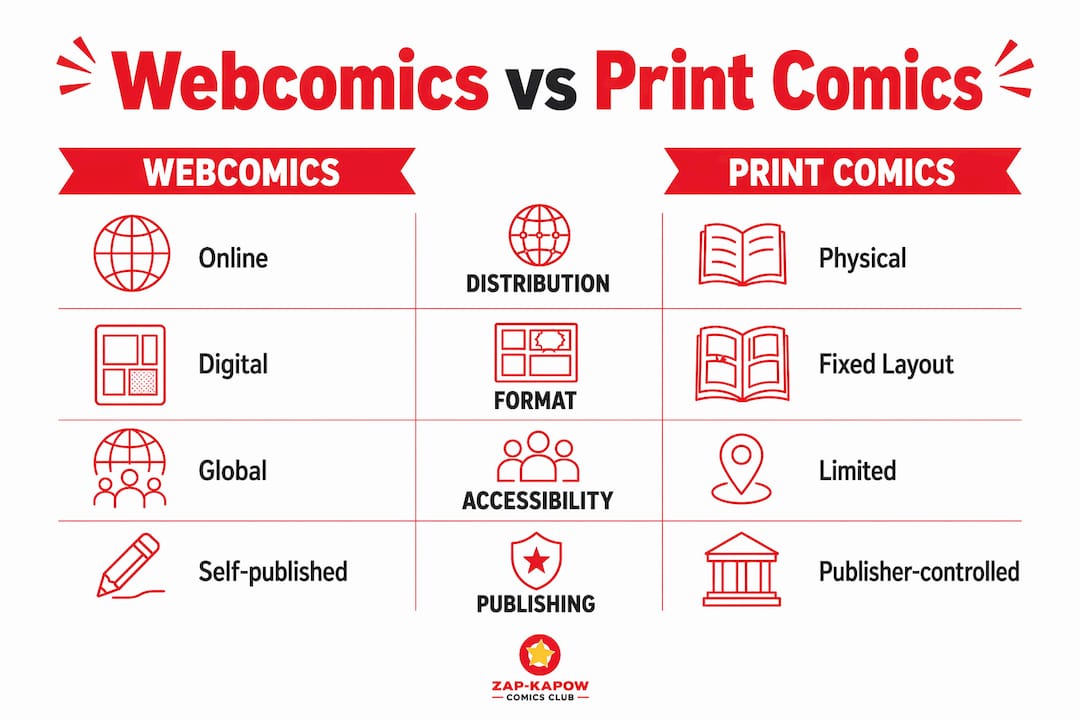
The digital format also allows page length flexibility, full color at no extra cost, and experimental layouts that print budgets would never support. That freedom is exactly why so many creators are choosing webcomics as their first publishing format.
Key advantages webcomics hold over print:
- No printing or distribution costs
- Global audience from day one
- Direct reader feedback through comments and ratings
- Freedom to experiment with panel layout and pacing
- Ability to update and correct published pages
What are the most popular types and genres of webcomics?
Webcomics cover every genre that exists in fiction, and then some genres that only work in the digital format. The range is genuinely wild, and that diversity is a big part of their appeal.
Slice-of-life comics like Sarah’s Scribbles by Sarah Andersen capture relatable everyday moments with simple art and sharp humor. Cyanide & Happiness goes the opposite direction with dark, absurdist comedy that built a massive cult following. On the long-form end, Kevin and Kell started in september 1995 and remains one of the longest-running webcomics in history. That kind of longevity proves webcomics can sustain serious storytelling over decades.
Genre variety is one of the strongest arguments for webcomics as a format:
- Slice-of-life: Sarah’s Scribbles, Poorly Drawn Lines
- Dark comedy: Cyanide & Happiness
- Fantasy/adventure: Long-form series on Webtoon like Tower of God and Lore Olympus
- Sci-fi: Experimental series exploring AI, space, and dystopia
- Romance: One of the most popular categories on Tapas and Webtoon
- Horror: Short-form anthology webcomics with single-sitting reads
The webcomic market in 2026 is vibrant, with platforms like LINE Webtoon and Toomics hosting thousands of series and millions of active readers. That scale has attracted Hollywood attention. Several webcomics have been adapted into Netflix series, video games, and print collections. Tower of God became an anime. Lore Olympus won an Eisner Award and landed a print deal with Random House. Webcomics are no longer a niche corner of comics culture. They are a legitimate pipeline for mainstream entertainment.
How to create a webcomic: tools, platforms, and tips for beginners
Creating a webcomic in 2026 is more accessible than ever, but it still requires planning, consistency, and the right tools. Here is a practical breakdown of how to get started.
Choosing your software
Free professional-grade tools like Krita and Medibang Paint let beginners produce high-quality art on a standard laptop. Clip Studio Paint is the paid industry standard, used by professionals on Webtoon and Tapas. All three support the panel layouts and export formats that major platforms require.
Picking your publishing platform
- Webtoon: The largest English-language webcomic platform, optimized for vertical scroll on mobile
- Tapas: Strong community features and a tipping/subscription model for creator revenue
- Comic Fury: A free hosting platform with strong customization for traditional page-format comics
Building your story before you launch
Detailed story bibles are often underestimated by new creators. A story bible is a document that maps your characters, world rules, and plot arcs before you draw a single panel. Skipping this step leads to writer’s block and plot inconsistencies that readers notice fast.
Production workflow tips
- Build a buffer. Publish your first episode only after you have 8 to 10 episodes ready. This protects you from missing update deadlines.
- Create character model sheets. Character model sheets keep your characters visually consistent across hundreds of panels. AI-assisted tools now help lock down character traits automatically.
- Pace for mobile. Hook readers before panel 40 in each episode. Readers on mobile scroll fast and drop off quickly if the story does not grab them early.
- Stick to a weekly schedule. Skipping more than three consecutive weeks causes significant audience loss due to platform algorithm penalties.
- Plan your episode endings. Each episode should end on a question, a cliffhanger, or an emotional beat that pulls readers back.
Pro Tip: Brad Guigar, one of the most respected voices in webcomics, says consistency beats quality in your first year. Ship on schedule, even if the art is not perfect. Audiences forgive rough art. They do not forgive disappearing creators.
Burnout is the number one reason new creators quit. Guigar recommends building that episode buffer before launch so you are never scrambling to meet a deadline. Check out this comic book club checklist for more practical advice on maintaining a consistent creative schedule.
What storytelling advantages do webcomics offer over other formats?
Webcomics give creators storytelling tools that print simply cannot replicate. The digital format is not just a delivery method. It is an active part of how stories are told.
Vertical scrolling changes the entire experience of reading a comic. In print, you turn a page and see everything at once. In a vertical scroll webcomic, the creator controls exactly when you see the next panel. That control creates suspense, comedic timing, and emotional impact in ways that page-turning never could. Digital-native storytelling allows creators to experiment with pacing, suspense, and visual rhythm using scroll mechanics that do not exist in print.
The creative advantages stack up fast:
- No length restrictions. An episode can be 10 panels or 100 panels based on story needs alone.
- Full color at no cost. Print color adds significant production expense. Digital color is free.
- Experimental layouts. Creators can use diagonal panels, overlapping art, and full-width splash images without worrying about print bleed.
- Real-time reader feedback. Direct feedback from readers influences creative direction in ways that traditional print publishing never allowed.
- Global reach from day one. A creator in Seoul and a creator in São Paulo both have access to the same global audience on Webtoon.
Webcomics also democratize graphic storytelling by lowering costs and barriers, which leads to a more diverse creator pool and a wider range of voices. Librarians and educators have highlighted this as one of the most significant cultural impacts of the format. Stories from communities that were historically underrepresented in print comics now reach millions of readers through platforms that cost nothing to join.
Key Takeaways
Webcomics are the most accessible and creatively free format in comics today, and the gap between a beginner creator and a published series is smaller than it has ever been.
| Point | Details |
|---|---|
| Webcomic definition | A webcomic is a comic published primarily online via websites or mobile apps. |
| Format freedom | Digital publishing removes print restrictions on color, length, and layout. |
| Popular platforms | Webtoon, Tapas, and Comic Fury are the top platforms for publishing and reading webcomics. |
| Consistency is critical | Skipping more than three consecutive weeks causes measurable audience loss on major platforms. |
| Diverse storytelling | Webcomics democratize comics by lowering barriers and amplifying underrepresented voices. |
Our take on where webcomics are headed
We have watched webcomics grow from a hobbyist curiosity into a genuine entertainment industry, and the trajectory is not slowing down. What strikes us most is how the format keeps rewarding creators who treat it seriously as a craft rather than a side project.
The consistency debate is real. We hear creators argue endlessly about whether it is better to publish polished work slowly or rough work regularly. The data and the experience of creators like Brad Guigar point clearly toward consistency winning in the early stages. Audiences on Webtoon and Tapas are conditioned by algorithms. Miss too many weeks and the platform stops showing your series to new readers. Quality matters, but it matters most once you already have an audience.
What excites us most about the current moment is the community layer. Webcomic readers are not passive. They comment, theorize, and sometimes directly influence story decisions. That feedback loop is unlike anything print comics ever offered. It creates a relationship between creator and audience that feels more like a conversation than a broadcast.
The future of webcomics is tied to mobile. As phone screens get better and reading habits shift further toward vertical scroll formats, the gap between webcomics and traditional entertainment keeps shrinking. We think the next decade will see more webcomic-to-screen adaptations, more creator-owned IP built on platforms like Webtoon, and more diverse voices telling stories that mainstream publishers would never have greenlit. That is genuinely exciting for anyone who loves comics.
Explore the world of comics with Zap-Kapow Comics Club
Whether you are diving into webcomics for the first time or you are a longtime collector tracking the value of your print collection, Zap-Kapow Comics Club has you covered.
Zap-Kapow Comics Club is the go-to platform for comic book enthusiasts who want to track collection value, monitor market trends, and discover what is hot right now. From raw issue prices to graded values, the Zap-Kapow Comics Club price guide puts real data behind your collection decisions. Want to see what titles are gaining traction? Check out the trending comic titles page for a live look at what collectors and fans are chasing. Webcomics and print comics both have a place in a great collection. Zap-Kapow Comics Club helps you manage both worlds without the chaos.
FAQ
What is the webcomic definition in simple terms?
A webcomic is a comic strip or graphic novel series published and distributed on the internet, typically through websites or mobile apps, and readable for free or through a subscription.
How do webcomics differ from manga or traditional comics?
Webcomics are self-published online without a traditional publisher, while manga and most American comics go through formal publishing houses. Webcomics also commonly use vertical scroll layouts optimized for mobile reading.
What are the best platforms for reading popular webcomics?
Webtoon and Tapas are the two largest English-language platforms, hosting thousands of series across every genre. Comic Fury is a strong option for traditional page-format webcomics with a dedicated community.
How do I start creating a webcomic as a beginner?
Start with free tools like Krita or Medibang Paint, build a buffer of 8 to 10 episodes before publishing, and commit to a weekly update schedule. Consistency matters more than perfect art in the first year.
Can webcomics make money?
Yes. Platforms like Tapas and Webtoon offer creator monetization through reader tips, subscriptions, and ad revenue. Popular series have also been adapted into Netflix shows, games, and print collections, creating additional revenue streams.