
A comic book universe guide is a curated roadmap that helps enthusiasts understand and navigate the complex multiverses, key characters, and landmark story arcs within franchises like DC and Marvel. These universes don’t just contain hundreds of characters. They contain decades of interconnected lore, reality-altering events, and parallel timelines that can feel like a mountain of continuity to climb. Whether you’re tracing Superman’s history through DC’s Earth-0 or following Spider-Man across Marvel’s Earth-616, knowing where to look makes all the difference. This guide breaks it all down so you can jump in with confidence.
1. What makes a comic book universe guide worth using?
A comic book universe guide works because it organizes continuity into navigable layers rather than forcing you to read everything in strict publication order. Comics are modular by design. You don’t need omniverse knowledge to enjoy a single story arc, and new readers benefit most from guides that organize entry points by era, character, or event. That’s the whole game. Pick a lane, learn the rules of that lane, then expand outward.
The best guides also acknowledge that continuity is a living thing. DC and Marvel have both rewritten their histories multiple times through major crossover events. A good superhero universe overview treats those rewrites as features, not bugs. They’re entry points, not obstacles.

2. The major comic book universes and what defines them
The two dominant universes in comics are the DC Universe and the Marvel Universe, and they take fundamentally different approaches to continuity.
DC Universe operates as a blended current continuity shaped by multiple timelines revised through reality-altering Crisis events. DC doesn’t pretend there’s one clean timeline. Instead, it layers revised histories on top of each other, resulting in a rich but sometimes tangled web of lore. The multiverse includes distinct Earths like Earth-0 (the main continuity), Earth-2 (the Golden Age Earth), and dozens of alternate realities.
Marvel Universe centers on Earth-616 as the mainstream Marvel continuity, existing within a larger multiverse of alternate universes. Earth-1610, known as the Ultimate Universe, ran as a separate continuity from the early 2000s and was designed specifically as a modern, accessible reboot of classic characters.
Here’s a quick comparison to keep things straight:
| Universe | Main Continuity | Multiverse Structure | Key Feature |
|---|---|---|---|
| DC Universe | Earth-0 (New 52/Rebirth era) | Infinite Earths, multiple numbered Earths | Continuity shaped by Crisis events |
| Marvel Universe | Earth-616 | Multiverse with alternate Earths | Modular, event-driven storytelling |
| Ultimate Marvel | Earth-1610 | Separate from Earth-616 | Modern retelling, standalone continuity |
Key things to know about each:
- DC’s multiverse allows characters to exist in multiple versions simultaneously across different Earths.
- Marvel’s Earth-616 is the anchor for nearly all major Avengers, X-Men, and Spider-Man stories.
- The Ultimate Universe (Earth-1610) is generally read separately from Earth-616 due to rare crossovers between the two.
- Independent publishers like Image Comics and Dark Horse operate their own self-contained universes with no multiverse overlap.
3. How major crossover events reshape comic book universes
Crossover events are universe-wide story arcs that alter the rules, history, or structure of a comic book universe. They’re not just big fights. They’re narrative resets that define what comes before and after.
DC’s Crisis events are the gold standard for this kind of storytelling. Crisis on Infinite Earths (1985) collapsed DC’s multiverse into a single Earth, wiping out decades of alternate continuity. Later events like Zero Hour, Infinite Crisis, and Flashpoint each triggered further resets, reshaping which version of characters like Barry Allen or Superman was considered “canon.” Understanding these events is the fastest way to understand why DC’s continuity feels layered rather than linear.
Marvel’s approach is different but equally impactful. Events like Secret Wars (2015) restructured the entire Marvel multiverse, merging multiple realities into Battleworld before restoring a revised Earth-616. The King in Black event, anchored by Knull’s arrival across multiple titles, showed how Marvel uses cross-title storytelling to build universe-wide mythology without a hard reset.
Here’s how to use crossover events as entry points:
- Identify the event that interests you. Crisis on Infinite Earths for DC history. Secret Wars or King in Black for Marvel mythology.
- Read the core miniseries first. Most events have a central limited series (usually 6 to 12 issues) that tells the main story.
- Add tie-in issues selectively. Tie-ins expand the story but aren’t always required. Check reading order guides to identify which ones matter.
- Use the event as a before/after marker. Everything published after a major Crisis or Secret Wars operates under new rules. That’s your new starting point.
- Don’t try to read every tie-in. Continuity fatigue is real, and it kills the fun fast.
Pro Tip: If you’re entering DC for the first time, Crisis on Infinite Earths is both a great story and a practical continuity reset marker. Everything after it operates under a cleaner (if still complex) framework.
4. Key characters and story arcs that anchor comic book universes
Flagship characters are the load-bearing pillars of any comic book universe. They’re the ones whose stories intersect with the most other titles, making them the best threads to pull when you want to understand how a universe connects.
In the DC Universe, Superman, Batman, and Wonder Woman anchor the Justice League era. Their individual titles cross over constantly, and major events almost always run through at least one of them. The Justice League itself functions as a hub title. Reading it gives you a bird’s-eye view of whatever crisis (literal or figurative) is shaking the DC Universe at any given moment.
In the Marvel Universe, Spider-Man, the X-Men, and the Avengers serve the same function. Spider-Man appears in more crossover events than almost any other character, making his titles a reliable throughline for tracking Marvel’s broader continuity. The X-Men operate somewhat separately due to their distinct social mythology, but they intersect with major events like House of X and Powers of X, which redefined mutant lore entirely.
Story arcs that function as lore anchors include:
- Fantastic Four #1 (1961): The Fantastic Four’s origin in this issue effectively launched the modern Marvel Universe. Reed Richards, Sue Storm, Johnny Storm, and Ben Grimm set the template for Marvel’s science-driven, character-focused storytelling.
- King in Black: Knull, the God of the Symbiotes, ties together decades of Venom and Carnage lore into a single cosmic-level event. Tracing Knull’s history gives you a master class in how Marvel builds mythology across titles over years.
- Crisis on Infinite Earths: For DC, this is the definitive lore anchor. It’s where the multiverse collapsed and modern DC continuity began.
- House of X / Powers of X: Jonathan Hickman’s 2019 X-Men relaunch redefined mutant society and connected decades of X-Men mythology into a new framework.
Pro Tip: Picking one or two cosmic-level anchors like Knull for Marvel symbiotes and tracing those arcs across titles is one of the most effective ways to map intricate universe connections without needing a full chronology.
5. Best strategies for newcomers entering complex comic universes
The single biggest mistake new readers make is trying to start at the beginning. With Marvel, “the beginning” is 1939. With DC, it’s even older. Nobody needs to do that.
Continuity in comic universes is navigational rather than strictly linear. You pick a universe branch, an era, or a character and follow that thread. Here’s how to do it without losing your mind:
- Choose your universe and era first. For Marvel, Earth-616 post-2012 (Marvel NOW! era) is a clean, accessible starting point. For DC, DC Rebirth (2016) offers a reader-friendly relaunch of most major titles.
- Separate main continuity from alternate realities. Don’t mix Earth-616 and Earth-1610 reading until you’re comfortable with both. Separating primary universes from alternate realities reduces confusion and allows a modular reading experience.
- Start with a character, not a universe. Pick Spider-Man, Batman, or the X-Men and read one complete run. Brian Michael Bendis’s Ultimate Spider-Man or Tom King’s Batman are both self-contained enough to enjoy without deep continuity knowledge.
- Use event-based anchors. Modern universe guides recommend era-based entry points like Marvel NOW! to make reading manageable and avoid overwhelm.
- Don’t read everything. Seriously. Comics reward focused reading. Pick a character or event, go deep, then branch out.
Pro Tip: DC Comics Presents (1978) is a great low-stakes way to explore DC Universe team-ups and get a feel for how characters interact before committing to a full run.
Key takeaways
A comic book universe guide works best when it treats continuity as a navigation tool rather than a strict reading requirement, letting fans enter through characters, events, or eras that genuinely interest them.
| Point | Details |
|---|---|
| Continuity is navigational | DC and Marvel universes are best entered by era or character, not from issue #1. |
| Crisis events are entry points | DC’s Crisis on Infinite Earths and Marvel’s Secret Wars function as before/after markers for continuity. |
| Flagship characters are throughlines | Spider-Man, Batman, and the X-Men intersect with the most titles, making them reliable guides through each universe. |
| Separate main from alternate | Keep Earth-616 and Earth-1610 reading separate until you’re comfortable with both continuities. |
| Use anchors, not full chronologies | Tracing one cosmic arc like King in Black maps universe connections without requiring complete reading order knowledge. |
Our take on navigating comic book universes
We’ve seen a lot of fans burn out trying to read comics “correctly.” Here’s the thing: there is no correct order. DC’s own continuity is described as a blended mix of timelines revised through multiple Crisis events. Even the publishers don’t maintain a single clean timeline.
What actually works is treating universe guides as ongoing tools rather than one-time orientation sessions. The Marvel and DC universes keep evolving. New events reshape old continuity. Characters die and return. Entire Earths get destroyed and rebuilt. Trying to master it all before you start reading is a trap.
Our advice: pick one character you love, find a critically praised run on that character, and read it. Then follow the threads that run out of it. That’s how you build genuine comic book lore knowledge. Not by memorizing every Crisis event, but by following the stories that grab you and letting the universe expand naturally from there. Universe guides like this one are maps, not mandates. Use them to orient yourself, then go wherever the stories take you.
Track your collection while you explore the multiverse
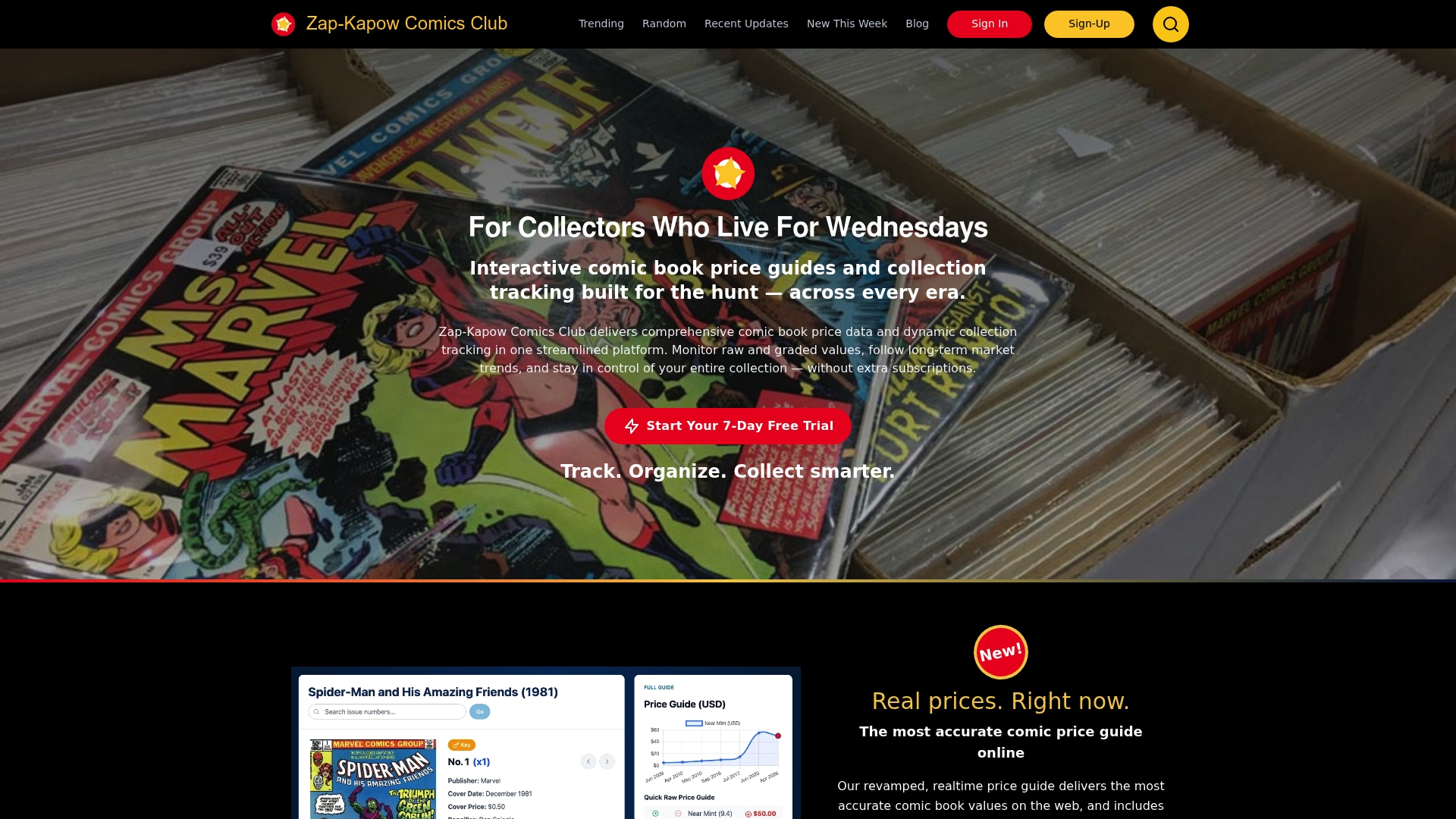
Exploring the DC and Marvel universes means collecting a lot of issues, and keeping track of what you own (and what it’s worth) gets complicated fast. Zap-Kapow Comics Club is built exactly for this. The platform gives you comprehensive price tracking for both raw and graded comics, long-term market trend data, and dynamic collection management without stacking extra subscriptions. Whether you’re hunting down key issues from the King in Black event or tracking the value of your Crisis on Infinite Earths run, Zap-Kapow Comics Club keeps everything organized in one place. Check out trending comic titles to see which universe story arcs are moving right now.
FAQ
What is a comic book universe guide?
A comic book universe guide is a structured resource that maps the key characters, continuities, and story arcs within a franchise like DC or Marvel, helping readers identify entry points and understand how titles connect.
What is the difference between Earth-616 and Earth-1610?
Earth-616 is Marvel’s main continuity, home to the core Avengers, X-Men, and Spider-Man stories. Earth-1610 is the Ultimate Universe, a separate modern retelling that runs independently and rarely crosses over with Earth-616.
Where should a new reader start with DC Comics?
DC Rebirth (2016) is the most accessible modern entry point, offering relaunched titles for Superman, Batman, and Wonder Woman with clear starting issues and minimal prior continuity required.
How do Crisis events affect DC continuity?
DC’s Crisis events, starting with Crisis on Infinite Earths in 1985, function as universe-wide resets that collapse or revise the multiverse structure. Each major Crisis redefines which version of characters and histories is considered current canon.
Do I need to read every tie-in issue during a Marvel crossover event?
No. Most Marvel crossover events have a core limited series that tells the complete story. Tie-in issues expand specific character threads but are rarely required to understand the main event narrative.
Recommended
- Comic Book Collecting 101: How to Start Your Collection (10 Essential Tips for New Collectors) - Zap-Kapow Comics Blog
- Comic Book Subscription Benefits: The 2026 Fan’s Guide - Zap-Kapow Comics Blog
- What Is a Comic Book Run? Meaning and Collector’s Guide - Zap-Kapow Comics Blog
- How Comic Book Auctions Work: A Bidder’s Guide - Zap-Kapow Comics Blog