
So you’ve spotted a raw copy of Amazing Fantasy #15 listed at an upcoming auction and your pulse just went through the roof. We get it. But before you throw your wallet at the screen, it pays to actually understand how comic book auctions work from the ground up. The process is far more structured than most first-timers expect. There are phases, deadlines, bidding mechanics, and post-auction logistics that can trip you up if you go in blind. This guide walks you through every stage, from catalog preview to pickup, so you can bid (and sell) with confidence.
Table of Contents
- Key takeaways
- How comic book auctions work: the full process
- Evaluating comic book lots before you bid
- Bidding strategies that actually work
- Post-auction responsibilities you cannot ignore
- What sellers need to know about comic auctions
- Our take on winning at comic auctions in 2026
- Track smarter, bid smarter with Zap-Kapow Comics Club
- FAQ
Key takeaways
| Point | Details |
|---|---|
| Auctions run in phases | Every comic book auction follows a staged timeline: preview, pre-bidding, live auction, and post-auction logistics. |
| “As is” means buyer beware | Comics sell without warranties, so inspection during the preview window is your only real protection. |
| Max bids prevent overbidding | Setting a firm maximum before bidding starts keeps emotions from running your budget off a cliff. |
| Post-auction fees add up fast | Storage fees kick in after pickup deadlines, so plan your logistics before you even place a bid. |
| Grading boosts seller returns | Professionally graded comics from CGC or CBCS consistently attract higher bids and more competitive buyers. |
How comic book auctions work: the full process
The comic book auction process runs in distinct phases, and each one matters. Auction houses use structured timelines that include preview windows, pre-bidding periods, a live closing session, and post-auction scheduling. Skip a phase or misread a deadline, and things go sideways fast.
Here is how the timeline typically plays out:
- Catalog preview. Auction houses publish lot descriptions, photos, and condition notes weeks in advance. This is your research window. Read every description carefully and flag the lots you want.
- In-person preview. Many houses allow physical inspection before bidding opens. If you can attend, do it. Photos lie. Condition issues you would never spot on a screen become obvious in person.
- Pre-bidding. This opens before the live session. You can set a maximum bid and the platform automatically increases your bid incrementally as competitors challenge you. It is low-pressure and strategic.
- Live auction. The auctioneer runs lots in real time while platforms accept multi-method bids including online, telephone, and absentee submissions. The pace is fast. Decisions happen in seconds.
- Post-auction. You have won. Now you schedule pickup or shipping, confirm payment, and manage logistics before deadlines hit.
Pro Tip: Register for the auction at least 48 hours before the live session. Most houses require identity verification and a credit card on file before they will approve your bids, and last-minute registrations sometimes get rejected.
Evaluating comic book lots before you bid
This is where most new bidders get burned. Understanding the condition of a comic book at auction is not optional. It is the difference between a bargain and an expensive mistake.

Professional grading from organizations like CGC (Certified Guaranty Company) or CBCS (Comic Book Certification Service) puts a numeric grade on a book and seals it in a tamper-evident case. A CGC 9.8 means something specific. It tells you the book is nearly perfect and the grade is certified by an independent expert. If you are bidding on a raw (ungraded) copy, you are doing your own assessment, which requires real knowledge of comic book grading standards.
Here is how to evaluate lots before committing a bid:
- Read the catalog description word for word. Auction houses invest in structured condition documentation to reduce buyer uncertainty, but the language can be dense. Words like “reading copy” or “spine stress” carry real meaning.
- Study every photo. Request additional photos if the listing feels sparse. Reputable houses will send them.
- Attend the preview window. Comics sell on “as is, where is” terms with no guarantees or warranties. The preview period is your only opportunity for due diligence.
- Understand the grade-to-value relationship. The difference between a 7.0 and an 8.0 on a key issue can translate to thousands of dollars. Check raw vs. graded values before you anchor to a price.
| Condition type | What it means for buyers |
|---|---|
| CGC/CBCS graded | Independent verification, tamper-evident case, grade is reliable |
| Raw, described | Buyer relies on house description and personal inspection |
| Raw, no description | Maximum risk, requires expert eye or pass |
| Restored | Major value impact, always disclosed but can be missed by new buyers |
Pro Tip: If you cannot attend the preview in person and the lot is worth real money to you, consider hiring a knowledgeable third party to inspect it on your behalf. A small consultation fee is nothing compared to the cost of a misgraded key issue.
Bidding strategies that actually work
Bidding on comic books at an auction is not just about wanting something badly enough. There is real strategy involved, and the collectors who win consistently are the ones who plan before the auction opens.
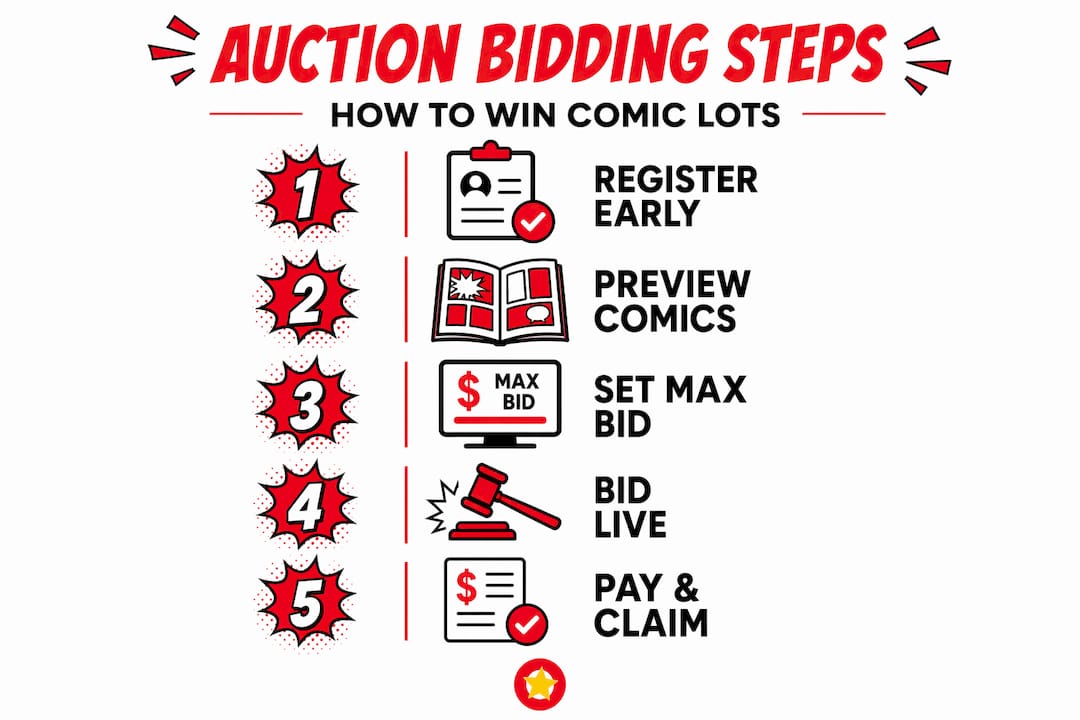
1. Set your maximum bid before emotions kick in. Setting a max bid before bidding prevents emotional overbidding during the live phase. Write the number down. Commit to it. That number should account for the buyer’s premium (typically 15% to 25% on top of the hammer price) and any shipping costs.
2. Use pre-bidding to your advantage. Pre-bidding lets you submit your maximum and walk away. The platform fights for you automatically up to your ceiling. It is a calmer, more calculated way to compete, especially on lots where you have a firm price in mind.
3. Know the difference between phases. Platforms run two-phase bidding where pre-bidding is automatic but the live phase requires manual increases. If you are active during the live session, you need to be watching and ready to respond. Missing a bid by 30 seconds can cost you the lot.
4. Track market pricing before you bid. Check recent comic price updates so you know what a book is actually worth in today’s market. Auction prices fluctuate based on media attention, key character appearances, and collector trends.
5. Avoid the “must have” mindset. Auction psychology is real. Late bidding and emotional responses drive prices up beyond fair market value on a regular basis. If a lot blows past your max bid, let it go. Another copy will surface. The market always brings more books to auction.
6. Bid odd numbers when possible. If your max is $500, bid $510 or $515. Many collectors anchor to round numbers, and a small increment above that threshold wins lots more often than you would think.
Pro Tip: Watch a full live auction session without bidding at least once before you participate. Observing how pace, increments, and emotional momentum play out in real time is one of the most practical forms of education you can get.
Post-auction responsibilities you cannot ignore
Winning a lot feels incredible. Then the real work starts.
Most auction houses require payment within three to five business days of the auction closing. Payment is typically accepted via wire transfer, credit card, or certified check. The buyer’s premium gets added on top of your winning bid automatically, so do not be caught off guard when the invoice arrives and the number is higher than your hammer price.
Pickup and shipping are where a lot of new buyers get surprised. Successful bidders must schedule pickup or shipping within 15 business days, and storage fees start applying after that window closes. At some houses, storage fees accumulate daily until day 60, after which items can be treated as abandoned. That is not a hypothetical. It happens.
Here is what to sort out immediately after winning:
- Confirm your invoice. Check the hammer price, buyer’s premium, and any additional fees before paying.
- Arrange shipping early. If you are not picking up in person, research third-party shipping services that specialize in fragile collectibles. Standard carriers are not always the best option for valuable comics.
- Plan for packaging. Graded slabs and raw books need proper mylar bags, boards, and rigid mailers. Coordinate with the auction house on how they will pack your lots.
- Communicate with the auction house. If you run into any timing issues, reach out immediately. Most houses are reasonable about extensions if you contact them proactively before a deadline passes.
What sellers need to know about comic auctions
Selling through auction is not always the right call, but when it is, it can generate returns that private sales simply cannot touch. The key is knowing how to set yourself up for success before the auction house ever lists your book.
Condition is everything. A professionally graded key issue from CGC or CBCS draws more bidders, more competition, and higher final prices than an equivalent raw copy. Grading costs money and time, but on high-value books, the return on that investment is well documented for sellers.
Reserve prices protect you from selling at a loss, but setting them too high kills bidding momentum. Most experienced sellers set reserves at or just below their minimum acceptable price, then let competition push the final number higher.
| Selling channel | Best for | Key consideration |
|---|---|---|
| Comic book auction | High-value keys and graded slabs | House fees typically 10% to 20% of sale price |
| Direct dealer sale | Quick liquidation of collections | Expect 40% to 60% of retail value |
| eBay or marketplace | Mid-tier books with active demand | Full control but requires effort and fees |
Pro Tip: Research which auction houses specialize in comic books specifically. A general collectibles house may bring fewer comic-focused bidders, which means less competition and lower final prices. Specialty drives results.
Also consider timing. Auctions tied to major comic conventions, new movie releases, or character anniversaries see stronger bidder turnout. Listing a key first appearance right before a highly anticipated film announcement is not insider trading. It is smart selling.
Our take on winning at comic auctions in 2026
In our experience watching collectors navigate auctions for years, the biggest mistake is not overpaying. It is under-preparing. Collectors who show up without knowing current market values, without inspecting lots during the preview window, and without a firm budget in mind are not really bidding. They are gambling.
The collectors we have seen clean up consistently at auctions are the ones who treat it like homework. They track pricing trends for 2026 before placing a single bid. They know the grade, the census population, and the recent sales history of every lot they want. They also know when to fold.
What I find genuinely exciting about the current auction market is that it has become more accessible without becoming less serious. Online bidding has opened the doors for collectors everywhere, but it has also created more competition. That means preparation is not just helpful. It is the only edge you actually have.
The best auction wins come from knowledge, not luck. Build your knowledge base, track the market rigorously, and let discipline do the heavy lifting.
Track smarter, bid smarter with Zap-Kapow Comics Club
Heading into a comic book auction without knowing current market values is like showing up to a poker game without knowing the rules. Not ideal.
Zap-Kapow Comics Club gives you the pricing intelligence you need to bid with confidence. The platform tracks both raw and graded values so you can see exactly what your target books are worth right now, not six months ago. You can monitor trending comic titles that are heating up at auction, catch recent market price shifts before the next live session, and manage your entire collection in one place. No extra subscriptions. No guessing. Just data-backed decisions. Visit Zap-Kapow Comics Club and get your collection dialed in before the next auction opens.
FAQ
How does the comic book auction process work?
Comic book auctions run in phases: catalog preview, pre-bidding, a live auction session, and post-auction pickup or shipping. Each phase has deadlines, and buyers must complete payment and logistics within set timeframes to avoid fees.
What does “as is, where is” mean at a comic auction?
It means the comic sells in its current condition with no guarantees or warranties from the auction house. Buyers are responsible for their own inspection during the preview window before placing bids.
What is a buyer’s premium at a comic book auction?
A buyer’s premium is an additional percentage added to your winning bid, typically between 15% and 25%, that represents the auction house’s fee. Always factor it into your maximum bid calculation before the auction starts.
What are the best comic book auction sites?
Reputable options include Alderfer Auction, Weiss Auctions, and Heritage Auctions, all of which specialize in or regularly feature comic books with multiple bidding options including online, phone, and absentee formats.
How do I avoid overbidding at a comic book auction?
Set a firm maximum bid before the auction opens and stick to it regardless of what happens during the live session. Auction psychology drives prices up fast, and having a pre-committed ceiling is the most reliable way to protect your budget.
Recommended
- How to Sell Your Comic Book Collection for Top Dollar: 5 Tips to Maximize Profit - Zap-Kapow Comics Blog
- Comic Collection Insurance Appraisal: A Collector’s Guide - Zap-Kapow Comics Blog
- How Comic Values Are Calculated: Rarity, Demand and Trends Explained - Zap-Kapow Comics Blog
- The Rise and Fall of the Comic Book Speculation Bubble: Lessons Learned - Zap-Kapow Comics Blog