
Your comic collection is worth real money. Maybe a lot of it. But if you’re relying on a standard homeowner’s policy to protect it, you’re probably sitting on a coverage gap that would hurt badly if something went wrong. A proper comic collection insurance appraisal is the only way to know your books are fully protected at their actual market value. This guide walks you through exactly how that process works, what to prepare, what to expect from a credentialed appraiser, and how to use the results to lock in the right coverage.
Table of Contents
Key takeaways
| Point | Details |
|---|---|
| Standard policies fall short | Homeowner’s insurance caps collectibles at $1,000–$2,500, leaving most collections severely underinsured. |
| Credentialed appraisers matter | Only ASA or AAA certified appraisers with comic expertise produce legally defensible insurance appraisals. |
| Agreed value beats cash value | Agreed value policies pay a pre-negotiated amount, avoiding depreciation disputes at claim time. |
| Reappraise every 2–3 years | Comic markets shift fast; outdated appraisals can leave you underinsured without realizing it. |
| Documentation multiplies protection | Photos, receipts, and grading certificates alongside your appraisal dramatically reduce claim disputes. |
Understanding comic collection insurance appraisal
Let’s start with the uncomfortable truth. Standard homeowner’s insurance caps collectibles coverage at $1,000 to $2,500 total. If your collection includes a CGC 9.8 Amazing Fantasy #15 or even a solid run of first-appearance keys, that cap is basically a rounding error. You need specialty coverage, and specialty coverage requires a professional appraisal.
Here’s how the three main policy types break down:
-
Scheduled coverage: Each comic is listed individually with an agreed value. This is the gold standard for high-value collections. It requires a current appraisal from a credentialed professional, but it pays out the full agreed amount without depreciation.
-
Blanket coverage: A lump sum covers the entire collection. Easier to set up, but it risks underinsurance if the total doesn’t reflect real market value. It still benefits from a professional appraisal to set that number accurately.
-
Specialty collectibles policies: Purpose-built for collectors. Specialty policies require appraisals dated within 3 to 5 years by credentialed professionals, and premiums typically run $0.50 to $2.00 per $100 insured depending on security and storage conditions.
One thing collectors often miss: the difference between agreed value and actual cash value. Agreed value policies maintain a pre-negotiated payout and avoid the depreciation arguments that plague actual cash value claims. For rare comics, that distinction can mean the difference between a fair settlement and a frustrating lowball offer.
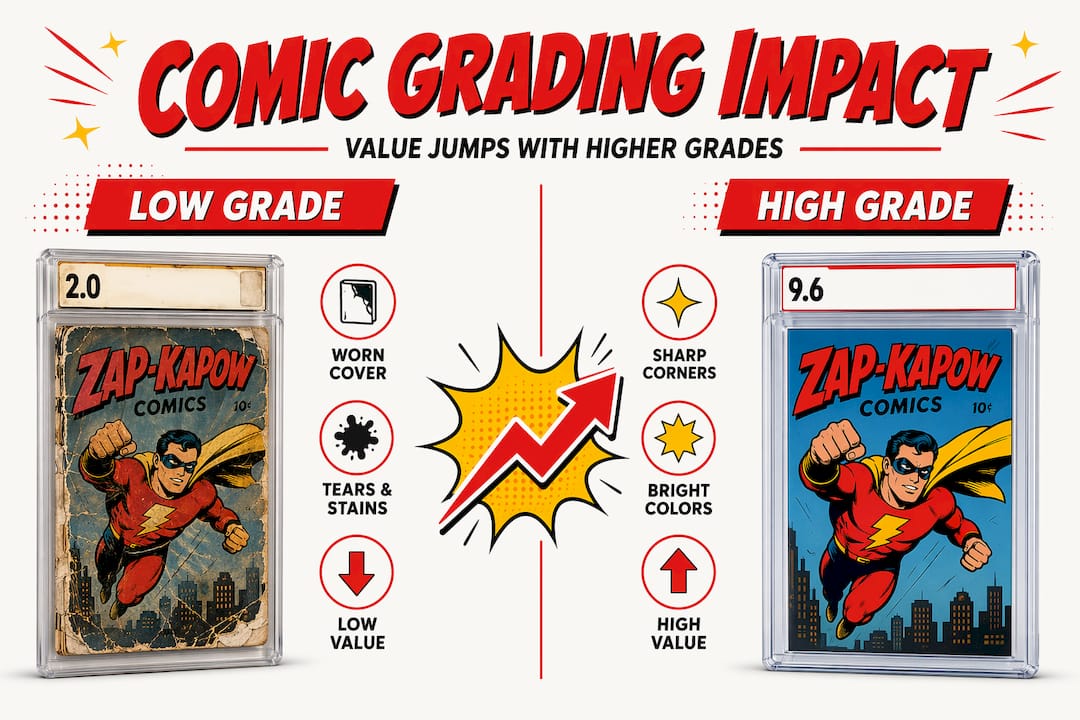
Condition grading also plays a massive role here. A CGC 9.8 can be worth 50 to 100 times more than the same issue in low grade. That kind of value spread means your appraiser needs to understand grading, not just general collectibles markets. More on that in a moment.
Finally, insurers require USPAP-compliant appraisals. USPAP stands for Uniform Standards of Professional Appraisal Practice. It’s the legal and ethical framework that makes an appraisal defensible in a claim or dispute. An informal valuation from a dealer or a price guide screenshot doesn’t cut it.
Preparing your collection for appraisal
Getting ready for a comic collection insurance appraisal isn’t just about pulling your boxes out of storage. The prep work you do beforehand directly affects the quality of the appraisal and the strength of your insurance coverage.
Here’s how to get your collection appraisal-ready:
-
Build a detailed inventory. Document every book with issue number, title, publisher, year, condition, and acquisition source. Include photos of front and back covers. A platform like Zapkapowcomics makes this dramatically easier than a spreadsheet, tracking both raw and graded values with market trend data baked in.
-
Decide which books to grade professionally. CGC grading costs $30 to $150 per book. Not every comic justifies that spend, but your high-value keys almost certainly do. Check out which comics are worth grading before you send anything off. A graded book with a CGC holder and cert number gives the appraiser a concrete, verifiable condition to work from.
-
Gather your documentation. Pull together purchase receipts, auction records, provenance notes, and any prior appraisals. Thorough documentation including photos, receipts, and provenance reduces disputes and speeds up claim recovery significantly. If you bought a key issue at a convention or through a private sale, write down what you remember while it’s still fresh.
-
Select a qualified appraiser. This is where collectors often stumble. You want someone with ASA (American Society of Appraisers) or AAA (Appraisers Association of America) credentials AND specific comic book expertise. Credentialed comic-specialist appraisers produce more defensible insurance appraisals than generalists who may lack the niche market depth to accurately value a Silver Age key or a high-grade Bronze Age run.
Pro Tip: Ask any prospective appraiser for sample reports and references from other comic collectors. A good appraiser will have no problem sharing those. If they hesitate, keep looking.
Understanding the difference between grading services also matters here. The CGC vs. CBCS vs. PGX comparison affects how appraisers and insurers view your graded books, so know what you have before the appraiser shows up.
The professional appraisal process: what to expect
Once you’ve selected your appraiser, the process follows a structured path. Knowing what’s coming helps you collaborate effectively and avoid delays.
| Phase | What happens | Your role |
|---|---|---|
| Scope agreement | Appraiser defines purpose, methodology, and which items are included | Confirm insurance replacement value as the goal |
| Data gathering | Physical or photographic inspection, condition assessment, market research | Provide inventory, grading certs, and documentation |
| Report generation | USPAP-compliant written report with replacement values per item | Review for accuracy and completeness |
| Delivery and scheduling | Report submitted to insurer for policy endorsement | File report and update coverage |
The scope agreement phase is more important than most collectors realize. Replacement value appraisals for insurance can differ by 30 to 50 percent from estate fair market value appraisals. Insurance appraisals focus on what it would cost to replace each item at current retail prices, not what they’d fetch at auction. Make sure your appraiser understands from the start that you need insurance replacement cost, not fair market value.
The appraisal report itself is a legal document. USPAP-compliant reports include item descriptions, condition notes, comparable sales data, and the appraiser’s methodology and credentials. Insurers use this report to schedule your items and set agreed values. Keep copies in multiple locations, including a digital backup.
Pro Tip: Ask your appraiser to include CGC cert numbers and population report data in the report. Population reports show how many copies exist at each grade, which directly supports the replacement value conclusion for rare high-grade books.
Cost-wise, expect to pay $150 to $500 for smaller collections and more for large or complex ones. Some appraisers charge per item, others charge hourly. Either way, the cost is trivial compared to the coverage gap it closes.
Using your appraisal to optimize coverage
You’ve got your appraisal report. Now what? This is where the rubber meets the road in terms of actually protecting your collection.
A few things to work through with your insurance agent:
-
Schedule your highest-value items individually. Scheduled coverage lists each item with an agreed value and pays out that full amount without depreciation arguments. Yes, it costs more in premiums, but for a CGC 9.8 key issue worth $10,000 or more, that certainty is worth every penny.
-
Use blanket coverage for lower-value books. A hybrid approach works well for most collectors. Schedule the keys, use blanket coverage for the rest. Just make sure the blanket total reflects your actual inventory value.
-
Push for agreed value over actual cash value. Agreed value policies give you financial clarity. Actual cash value policies can leave you arguing about depreciation after a loss, which is the last thing you want after a fire or theft.
-
Store your documentation alongside the appraisal. Photos, grading certificates, purchase receipts, and the appraisal report should all live together, both physically and digitally. Detailed documentation supporting appraisals significantly affects claim outcomes and reduces underpayment risks.
-
Schedule reappraisals every 2 to 3 years. Comic markets move fast. A book worth $500 in 2022 might be worth $3,000 today thanks to a movie announcement or a sudden surge in collector interest. Frequent reappraisals are recommended for volatile collectibles markets to keep coverage current.
Understanding how comic values are calculated gives you a real edge when reviewing your appraisal report and discussing coverage levels with your insurer.
Common pitfalls to avoid
Even collectors who take insurance seriously make avoidable mistakes. Here are the ones that show up most often.
The biggest one? Confusing an informal valuation with a real appraisal. A dealer telling you your collection is “worth around $20,000” is not an appraisal. Neither is a price guide lookup or a completed eBay listing search. Formal USPAP-compliant appraisals are legally defensible documents. Informal valuations are not. Insurers know the difference, and they’ll use it against you at claim time.
Not updating appraisals is the second big mistake. Markets shift. A collection appraised in 2021 may be significantly undervalued today, or in some cases overvalued, depending on what’s happened in the market. Either way, stale numbers mean your coverage doesn’t match reality.
Choosing a generalist appraiser over a comic specialist is another trap. Someone who appraises fine art, jewelry, and furniture on the side doesn’t have the market depth to accurately value a high-grade Silver Age run or a modern variant with a limited print count.
“The difference between a credentialed comic specialist and a generalist appraiser isn’t just credentials. It’s the ability to pull accurate comparable sales from comic-specific auction records, understand CGC population data, and recognize what drives value in a niche market that moves nothing like the broader collectibles world.”
Finally, don’t neglect your ongoing inventory. An appraisal is a snapshot in time. If you keep buying and selling without updating your records, your coverage drifts out of alignment fast.
Our take on why this matters more than ever
We’ve talked with a lot of collectors over the years who treat insurance as an afterthought. They’ve spent years hunting down keys, chasing high grades, and building something genuinely impressive. Then they assume their homeowner’s policy has it covered. It doesn’t. Not even close.
What we’ve seen happen in real claims is frustrating. Collectors get lowball settlements because they couldn’t prove value. They had no appraisal, no documentation, no grading certs. Just boxes of books and a gut feeling about what they were worth. Insurers don’t pay on gut feelings.
The comic market has also matured significantly. Books that were $200 raw copies five years ago are now $2,000 CGC 9.8s. That kind of appreciation is great for collectors, but it also means the gap between what you think you’re covered for and what you’re actually covered for keeps widening if you’re not paying attention.
Our honest advice: treat the appraisal process the same way you treat grading a key book. It’s an investment in protecting what you’ve built. The cost is real but small relative to what’s at stake. And understanding raw vs. graded value differences before you walk into an appraisal will make you a much more informed participant in the process.
Don’t wait for a loss to find out your coverage was inadequate. Get the appraisal, schedule your keys, and update it regularly. Your collection deserves that level of care.
Track your collection value with Zap-Kapow Comics Club
Before you call an appraiser, you need to know what you’ve got. That’s where Zap-Kapow Comics Club comes in.

Zap-Kapow Comics Club delivers real-time price data for both raw and CGC-graded comics, long-term market trend tracking, and a full collection management platform in one place. When you walk into an appraisal with a detailed, up-to-date inventory and current market values already documented, the whole process goes faster and costs less. You can explore current market trends to see which titles are moving right now, or dig into specific title data like the X-Force 1991 price guide to understand how values have shifted over time. Whether you’re prepping for your first appraisal or updating coverage on a collection you’ve been building for decades, Zap-Kapow Comics CLub gives you the data foundation that makes everything else easier.
FAQ
What does a comic collection insurance appraisal cost?
Professional appraisals for comic collections typically run $150 to $500 for smaller collections, with larger or more complex collections costing more. Appraisers may charge per item or hourly, and the cost is minor compared to the coverage gap it closes.
How often should I get my comic collection reappraised?
Reappraisals every 2 to 3 years are recommended for comic collections, since market values in this space can shift dramatically in short periods due to media announcements, demand surges, and grading population changes.
Does CGC grading affect my insurance appraisal?
Yes, significantly. A CGC 9.8 can be worth 50 to 100 times more than the same issue in low grade, so graded books with verified condition give appraisers a concrete, defensible basis for replacement value conclusions.
What is the difference between agreed value and actual cash value for comics?
Agreed value policies pay a pre-negotiated amount at claim time with no depreciation. Actual cash value policies factor in depreciation, which can result in much lower payouts for collectibles that have appreciated in value.
Can I use a dealer’s valuation instead of a professional appraisal?
No. Dealer estimates and price guide lookups are informal valuations and are not legally defensible for insurance scheduling or claims. Insurers require USPAP-compliant appraisals from credentialed professionals to establish agreed value for scheduled coverage.