
Comic valuation is the process of estimating a comic book’s fair market value based on condition, grading, recent sales, rarity, and demand. Getting it right matters whether you’re buying a key issue, selling part of your collection, or deciding whether to slab that raw copy sitting in your long box. The comic valuation methods compared here cover everything from sale price tracking and CGC grading to price guides and raw book estimates, so you can pick the right approach for your situation and stop leaving money on the table.
1. Comic valuation methods compared: why sale price tracking wins
Sale price tracking is the most reliable foundation for any comic book value assessment. It measures what buyers actually paid, not what sellers hope to get. Asking prices are speculative; only completed sales reveal true buyer interest and fair value.
The key rule here: only sold listings from the last 90 days count as reliable indicators of current market liquidity. Anything older risks reflecting a market that no longer exists. eBay completed listings and major auction house archives are the go-to sources for this data.
When filtering comparable sales, match on four things:
- Grade: A CGC 9.8 and a raw VF/NM are not the same comparison.
- Edition: First print, newsstand, and direct editions trade at different prices.
- Restoration status: Restored copies sell at steep discounts to unrestored equivalents.
- Provenance: Pedigree copies or creator-signed books can command premiums.
Pro Tip: Filter your eBay completed listings to “sold” only, then sort by most recent. Ignore outliers at both ends of the price range and use the middle cluster as your benchmark.
2. Graded comic book valuation and what it actually costs you
Graded comics, meaning books encapsulated and assessed by a third-party grading company like CGC, trade on certainty. Slabbed books command higher prices because buyers know exactly what condition they are getting. That reduced uncertainty is worth real money in the market.

CGC population reports add another layer to graded comic valuation. A book with only three copies in CGC 9.8 is a very different investment than one with 3,000. Low population at high grades drives scarcity premiums, sometimes dramatically.
The catch? CGC grading fees, shipping, and insurance add up fast. These costs must factor into your net return calculation before you decide to grade anything.
Here is what to weigh before submitting a book:
- Grading tier fees: Economy, standard, and walkthrough tiers carry different price points.
- Pressing and cleaning costs: Many collectors press books before grading to improve the grade outcome.
- Shipping and insurance: Round-trip costs on a heavy submission add up quickly.
- Grading risk: A book you think is a 9.6 might come back a 9.2, changing the math entirely.
Pro Tip: Grading makes financial sense when the raw-to-graded value spread comfortably exceeds all-in costs. For lower-value books, the math rarely works. Focus grading submissions on high-demand key issues where a certified grade meaningfully moves the sale price.
3. Raw comic book valuation and how to estimate it honestly
Raw comics are ungraded books, and they make up the majority of collections out there. They appeal to collectors who want flexibility, lower upfront costs, and the thrill of the hunt. But raw books should be valued 30–50% lower than equivalent graded copies to account for grading risk and market caution. That discount is not a flaw in the market. It reflects real uncertainty about condition.
Estimating raw value requires honest self-assessment. Collectors must assign a conservative grade range, not a best-case fantasy, when valuing ungraded books. Overestimating grade is the single most common raw valuation mistake.
When buying raw makes sense:
- You plan to read or display the book and do not need a slab.
- The grade spread between raw and graded does not justify submission costs.
- You have the grading knowledge to spot undervalued raw copies at shows or shops.
- You want to flip a raw book quickly without the time cost of grading.
When graded is the smarter buy:
- You are investing in a high-value key issue where condition certainty matters.
- Liquidity is important and you may need to resell quickly.
- The book is fragile or restoration-suspect and you want third-party verification.
The total cost of grading raw comics includes purchase price, shipping, pressing, grading fees, and insurance. Run those numbers before assuming raw-to-graded arbitrage will pay off. It often does not.
4. Using price guides and understanding their real limitations
Price guides are the starting point most collectors reach for first. They provide fast value ranges by grade and give a broad sense of a book’s historical worth. For building a mental map of the market, they are genuinely useful.
The problem is that price guides can mix in outdated or aspirational data. A guide updated annually cannot reflect a book that spiked last month because a character appeared in a streaming trailer. Relying on guides alone is how collectors overpay or undersell.
Here is how to use price guides the right way:
- Use them as a starting range, not a final answer. A guide value tells you the ballpark. Completed sales tell you the actual price.
- Check the update frequency. A guide updated quarterly is more useful than one updated annually for hot books.
- Cross-reference with auction results. Price guides must be verified against actual sale and auction results to be trustworthy.
- Treat them as historical context. Guides are excellent for understanding long-term trends and which grades have historically commanded premiums.
Zapkapowcomics integrates price guide data with real market trends so collectors can see both the historical picture and current sale activity in one place.
5. The low-middle-high estimate method for reliable appraisal
The most reliable comic book appraisal method uses a range, not a single number. Using a low, middle, and high estimate derived from comparables adjusted for grade, restoration, and provenance gives the most defensible valuation. This approach is standard practice among serious collectors and auction specialists.
The low estimate reflects the floor: what the book would sell for quickly in a soft market. The middle estimate is your realistic target price. The high estimate captures what a motivated buyer in peak demand might pay. Knowing all three gives you negotiating confidence whether you are buying or selling.
Grade drives auction results more than any other single factor, but eye appeal and restoration status also shift prices within the same numeric grade. Two CGC 8.0 copies of the same book can sell for meaningfully different prices if one has exceptional white pages and the other has a small color touch. That nuance is why the low-middle-high method beats a single-point estimate every time.
6. Situational guide: choosing the right valuation method
Different collecting and investing goals call for different approaches to how you value comics. There is no single best method for every situation. The right tool depends on what you are trying to accomplish.
Buying raw offers flexibility and lower costs, while graded comics offer confidence and liquidity. That tradeoff shapes which valuation method you should lean on.
| Situation | Best method | Why |
|---|---|---|
| Casual collecting | Price guide + recent sales | Fast, low-effort, good enough for personal enjoyment |
| Investing in key issues | Sale price tracking + CGC data | Accuracy and liquidity matter most |
| Deciding to grade a raw book | Raw-to-graded spread analysis | Net return after all costs must justify submission |
| Quick resale | Completed sales (last 90 days) | Reflects current buyer willingness to pay |
| Long-term portfolio tracking | All methods combined | Trends, grades, and sales together give the full picture |
Pro Tip: The biggest valuation mistake collectors make is anchoring on a single data point, whether that is a guide price, a high-end auction outlier, or a friend’s opinion. Always triangulate across at least two methods before committing to a buy or sell price.
Staying current on comic pricing trends in 2026 also matters. Market liquidity shifts with media announcements, convention season, and grading company policy changes. A valuation method that worked perfectly last year may need recalibration today.
Key takeaways
The most accurate comic book value assessment combines recent completed sales data, graded comparables, and a conservative condition estimate rather than relying on any single method alone.
| Point | Details |
|---|---|
| Sale price tracking is the foundation | Only completed sales from the last 90 days reflect true market value. |
| Raw books carry a built-in discount | Value raw copies 30–50% below graded equivalents to account for condition risk. |
| Grading costs affect net returns | Factor in fees, shipping, pressing, and grading risk before submitting any book. |
| Price guides need verification | Always cross-reference guide values against recent auction and sale results. |
| Use a range, not a single number | Low, middle, and high estimates from comparables give the most reliable appraisal. |
Our take on comic valuation
We have seen collectors make the same mistakes over and over, and almost all of them trace back to one thing: trusting the wrong data source. Asking prices on marketplace listings are not valuations. They are wishes. The market does not care what a seller thinks their book is worth. It cares what a buyer actually paid last week.
The other trap we see constantly is the grading math problem. Collectors buy a raw book, get excited about its potential grade, and mentally skip past the pressing fees, the shipping costs, the grading tier, and the very real chance the book comes back a grade lower than expected. The raw-to-graded arbitrage is often slimmer than anticipated once all costs are accounted for. Run the numbers cold before you get emotionally attached to a submission.
Our honest recommendation: use sale price tracking as your anchor, layer in graded population data for key issues, and treat price guides as historical context rather than gospel. And if you are collecting for the love of the medium rather than pure investment return, give yourself permission to value a book by how much joy it brings you. Not everything needs a CGC label to be worth keeping.
Zap-Kapow Comics Club: your comic valuation home base
Knowing the right valuation methods is one thing. Having the data to apply them is another. Zap-Kapow Comics Club puts trending comic prices and key issue values right at your fingertips, updated to reflect current market activity rather than stale guide data.
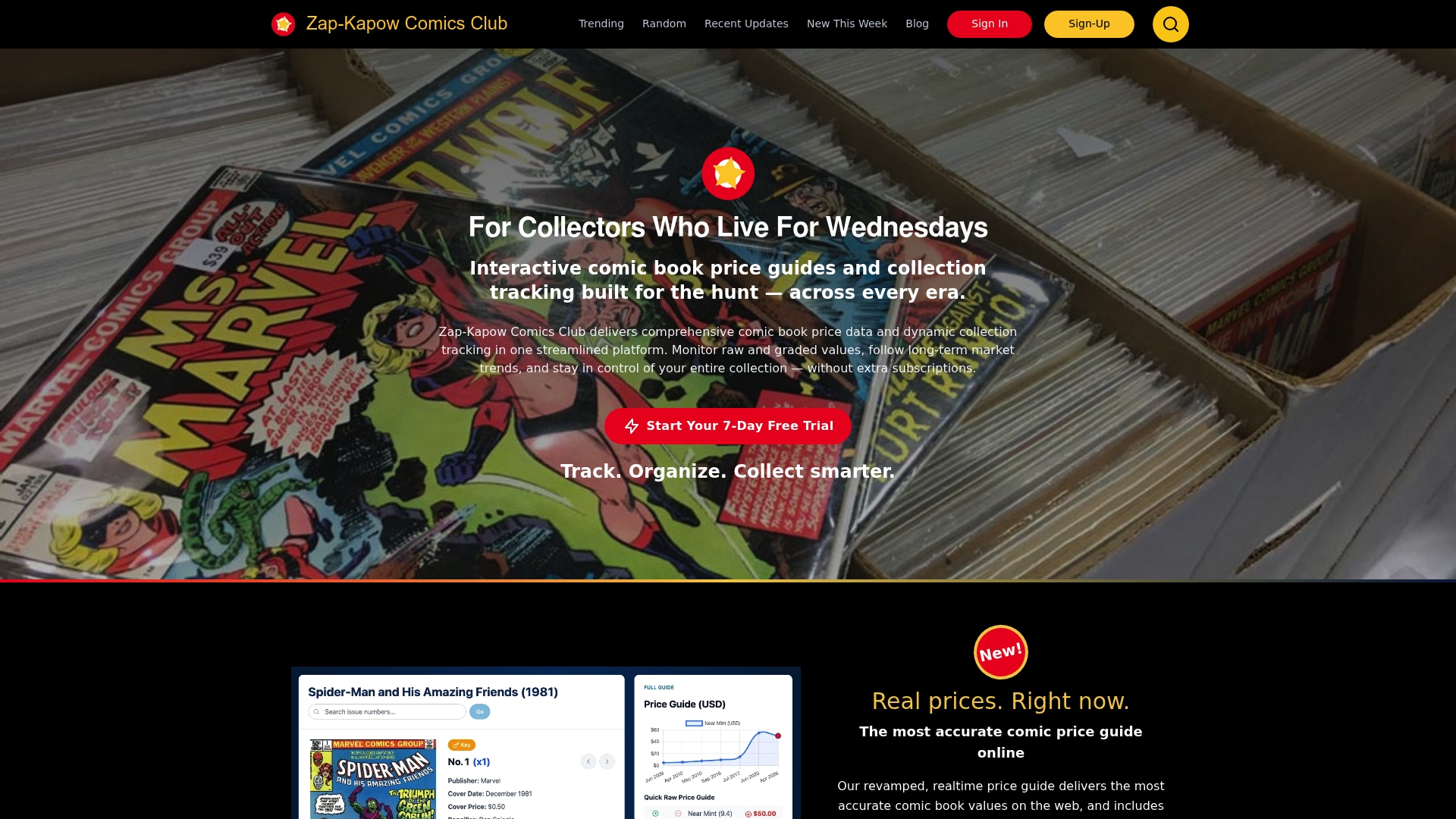
Whether you are tracking raw and graded values across your collection, researching a potential buy, or watching long-term market trends on titles like Witness Point (2026), Zap-Kapow Comics Club gives you the data to make confident decisions. No extra subscriptions. No guesswork. Just real numbers for real collectors.
FAQ
What is the most reliable method for valuing a comic book?
Sale price tracking using completed listings from the last 90 days is the most reliable method. It reflects actual buyer behavior rather than speculative asking prices or outdated guide data.
How much less is a raw comic worth compared to a graded copy?
Raw comics are typically valued 30–50% lower than equivalent graded copies. That discount accounts for grading risk and the uncertainty buyers accept when purchasing an ungraded book.
Are comic book price guides accurate?
Price guides provide useful value ranges by grade but can include outdated or aspirational pricing. They work best when cross-referenced with recent auction results and completed sale data.
When does it make financial sense to grade a raw comic?
Grading makes sense when the spread between raw and graded sale prices clearly exceeds all-in costs including fees, pressing, shipping, and insurance. For lower-value books, the math rarely works in the collector’s favor.
What factors affect comic book value beyond grade?
Eye appeal, restoration status, provenance, population report data, and market demand all influence final sale prices. Two books at the same numeric grade can sell for very different amounts based on these factors.
Recommended
- Comic Collection Insurance Appraisal: A Collector’s Guide - Zap-Kapow Comics Blog
- How Comic Book Price Guides Work: A Collector’s Guide - Zap-Kapow Comics Blog
- Factors Affecting Comic Book Value: A Collector’s Guide - Zap-Kapow Comics Blog
- Comic Grade Impact on Value: A Collector’s 2026 Guide - Zap-Kapow Comics Blog