
Comic book storage is the practice of preserving collectible comics by keeping them upright in climate-controlled environments, inside acid-free bags and boards, and within protective boxes that maintain condition and grade value. Get this wrong and a near-mint copy of X-Force #1 can degrade into a reading copy in a few years. Get it right and your collection holds its value for decades. Whether you’re protecting a single key issue or a mountain of long boxes, the fundamentals of comic book preservation come down to three things: environment, materials, and handling.
What are the best environmental conditions for storing comic books?
Environment is the foundation of comic book preservation. No bag or board in the world can save a comic stored in a hot, damp attic. Cooler, drier, darker environments matter more than any premium accessory you can buy.
The ideal conditions for long-term storage are:
- Temperature: Keep storage areas between 65–70°F (18–21°C). Heat accelerates paper degradation and causes colors to fade faster than you’d expect.
- Relative humidity: Aim for 45–55%. Too much moisture breeds mold and causes pages to warp. Too little makes paper brittle.
- Light exposure: Keep comics away from direct sunlight and fluorescent lighting. UV rays yellow paper and bleach ink. A dark closet beats a bright display shelf every time.
- Air quality: Avoid damp basements and spaces near exterior walls. Stale, humid air carries mold spores that will eat through your collection silently.
- Floor clearance: Concrete floors transmit moisture invisible to the eye. Store boxes on shelving or pallets, never directly on the floor.
A climate-controlled interior closet away from exterior walls is the gold standard location. Attics and garages are the worst offenders because temperature and humidity fluctuate wildly in those spaces, damaging comics faster than almost any other factor.
Pro Tip: Pick up an inexpensive digital thermometer and hygrometer combo. Place it near your storage boxes and check it weekly. You’ll catch humidity spikes before they cause mold.
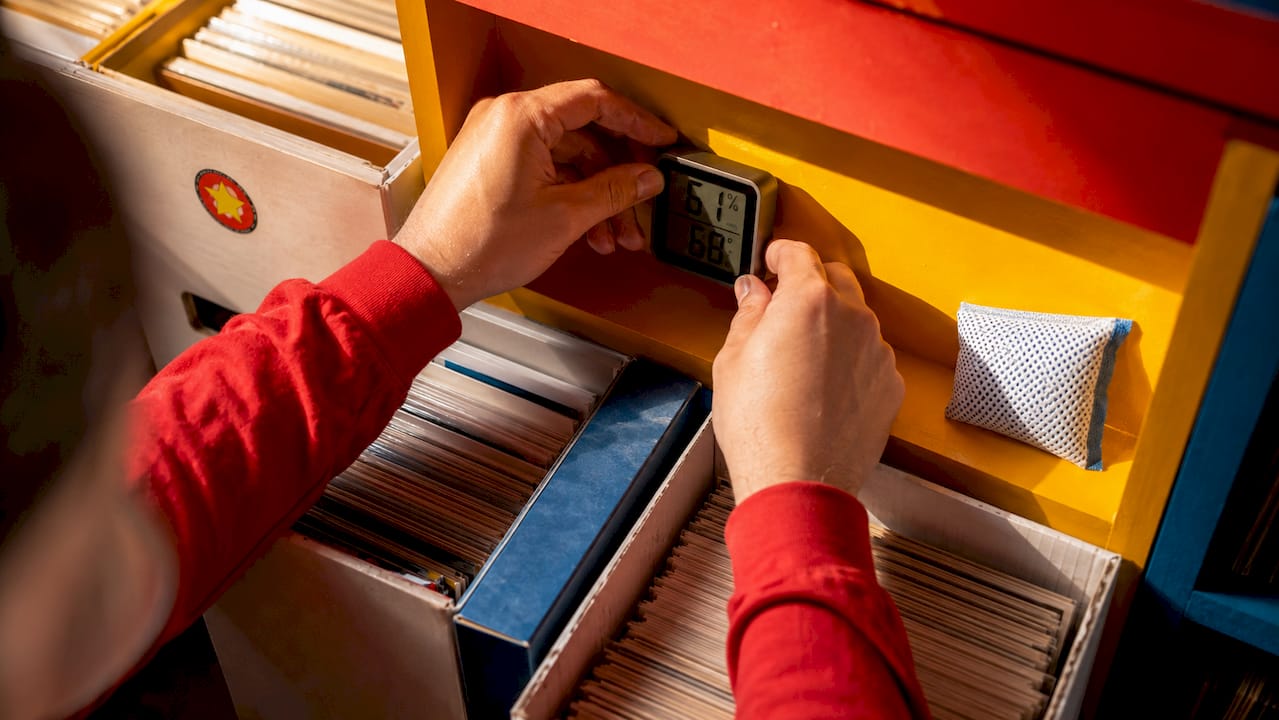
Monitoring your environment costs almost nothing. Replacing a degraded collection costs a lot.
What materials and tools are essential for proper comic book storage?
The right materials create a physical barrier between your comics and the elements. The wrong ones accelerate the damage you’re trying to prevent.
Here’s what every collector needs:
- Acid-free, lignin-free backing boards. Full-size boards support the comic’s spine and body. Buffered boards are best because they neutralize acid migration from the paper itself. Backing boards are consumables and must be replaced every few years as they saturate with acid and lose their protective function.
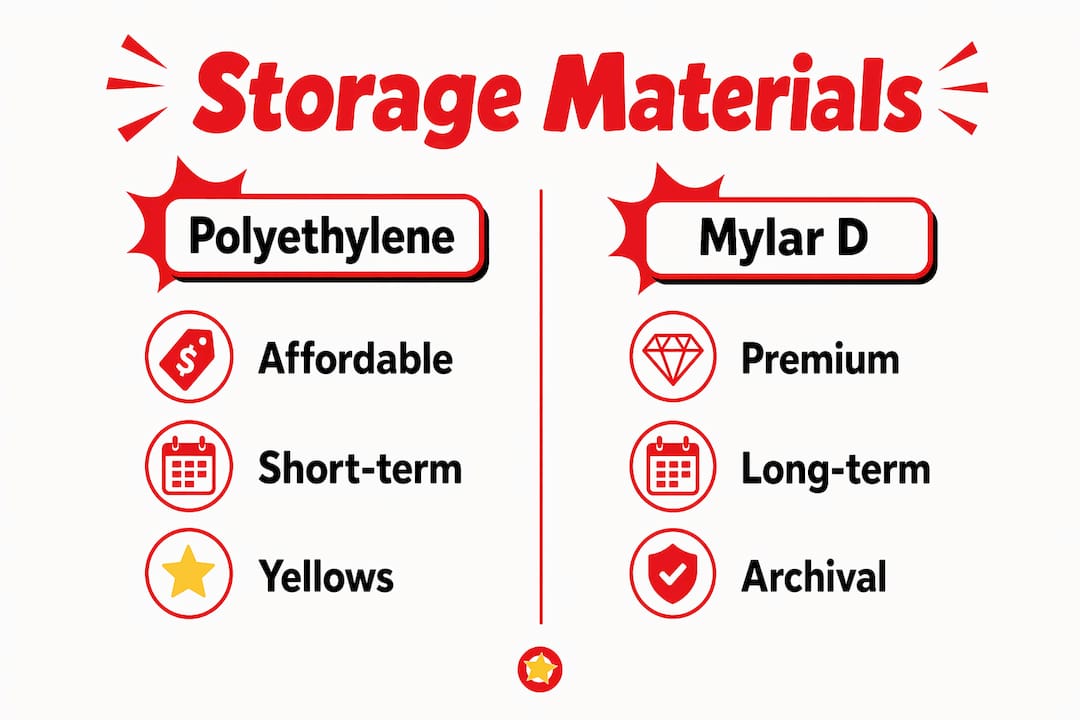
- Mylar D bags for long-term storage. Mylar D does not off-gas or yellow for decades. It’s the gold standard for key issues and vintage books. Standard polyethylene or polypropylene bags work for general collections but require replacement every 5–7 years.
- No PVC bags, ever. PVC off-gases hydrochloric acid that destroys paper over time. If you inherited a collection stored in soft, flexible bags that smell slightly chemical, those are likely PVC. Replace them immediately.
- Short boxes or long boxes. Short boxes hold about 150 comics and are lighter and easier to manage. Long boxes hold about 250 but become heavy and awkward fast. For most collectors, short boxes reduce the risk of overpacking and spine damage.
- Properly sized bags and boards. Current-size comics need current-size supplies. Golden Age books need Golden Age supplies. Forced insertion into undersized bags causes spine bends that kill grade value instantly.
Pro Tip: When bagging a comic, slide the board in first, then the comic on top of the board. The board should sit flush with the comic’s edges. If you’re forcing it, the bag is too small.
Here’s a quick comparison of the most common bag types:
| Bag type | Longevity | Best use | Risk |
|---|---|---|---|
| Mylar D | Decades | Key issues, vintage books | Higher cost |
| Polyethylene | 5–7 years | General collections | Needs periodic replacement |
| Polypropylene | 5–7 years | General collections | Needs periodic replacement |
| PVC | Harmful immediately | None | Off-gases acid, destroys paper |
The cost difference between Mylar D and polyethylene is real. For your most valuable books, Mylar D is worth every cent. For reading copies and lower-value issues, polyethylene works fine as long as you replace it on schedule.
How should you organize and physically store your collection?
Physical organization protects comics just as much as the materials you use. A perfectly bagged comic stored flat under a stack of boxes will still get damaged.
- Store comics upright, always. Horizontal stacking puts uneven pressure on spines and causes warping. Upright storage distributes weight evenly across the stack.
- Do not overfill boxes. Comics should stand snugly but not be crammed in. If you need two hands and a prayer to pull one out, the box is too full. Overpacking causes spine roll and corner damage.
- Keep boxes off the floor. Shelving units or wire racks keep boxes elevated and allow air to circulate underneath. This is especially critical in any space where humidity can creep up from below.
- Label your boxes. A simple label system (by title, era, publisher, or alphabetical order) saves you from digging through every box to find a single issue. Your future self will thank you.
- Consider premium storage for high-value books. Graded slabs from CGC or CBCS should be stored upright in dedicated slab boxes. Stacking slabs horizontally can warp inner wells and damage the case.
For collectors with limited space, vertical shelving units with short boxes are the most space-efficient setup. You can stack short boxes two high safely without the weight becoming unmanageable. Going three high starts to put real pressure on the bottom box and the comics inside it.
Check out the Zap-Kapow Comics Club guide on organizing your collection for more detailed layout strategies tailored to different collection sizes.
What common mistakes harm comic book collections?
Even collectors who know the basics make mistakes that quietly degrade their books over time. Here are the ones that cause the most damage:
- Storing in attics, garages, or basements. These spaces have the worst temperature and humidity swings. A comic stored in a garage in Phoenix or a basement in Seattle is fighting the environment every single day.
- Using non-archival materials. Cheap bags and boards yellow and warp. They transfer acid directly to your comics. The savings upfront cost far more in damaged books later.
- Overpacking boxes. This is one of the most common mistakes. Spine roll from a packed box is permanent and drops grade value significantly.
- Skipping annual inspections. Comics should be reviewed annually for signs of mold, odor, or damage. Catching a problem early can save an entire box. Ignoring it means losing the whole thing.
- Never replacing backing boards. Boards are not a one-time purchase. They absorb acid over time and eventually become part of the problem. Replace them every few years, especially for high-value books.
Pro Tip: Set a calendar reminder once a year to open your boxes and do a quick inspection. Check for musty smells, yellowing, or any signs of moisture. Catching mold early is the difference between a bad day and a catastrophic loss.
The archival printing and preservation field uses the same core principles: acid-free materials, stable environments, and regular inspection. Comic collectors and archivists are solving the same problem at different scales.
Environment stabilization is the foundation of collection preservation. Fancy accessories stored in a bad environment will still fail. A basic setup in a stable, cool, dry, dark space will outperform premium gear in a garage every single time.
Key Takeaways
Proper comic book storage requires a stable environment first, archival-quality materials second, and consistent inspection habits to protect both condition and long-term value.
| Point | Details |
|---|---|
| Environment comes first | Keep storage at 65–70°F and 45–55% humidity in a dark, interior space. |
| Use the right bags | Mylar D lasts decades; replace polyethylene bags every 5–7 years; never use PVC. |
| Boards are consumables | Replace acid-free backing boards every few years before they saturate and cause damage. |
| Store comics upright | Horizontal stacking and overpacked boxes cause spine roll and permanent grade loss. |
| Inspect annually | Check for mold, odor, and material degradation once a year to catch problems early. |
Our take on long-term collection discipline
We’ve seen collectors spend serious money on premium Mylar D bags and then store their boxes in a garage that hits 95°F every summer. The bags do nothing in that environment. The single biggest upgrade any collector can make is not a new bag or a fancy cabinet. It’s moving the collection to a climate-controlled space.
Backing boards deserve more attention than they get. Most collectors bag and board once and assume the job is done. But boards absorb acid from the comic paper itself over time. A board that’s been in place for five or six years without replacement is no longer protecting your book. It’s slowly harming it. Treat boards like a consumable, the same way you’d replace a water filter.
Minimal handling also matters more than most collectors realize. Every time you pull a comic out of its bag, you risk spine stress, fingerprints, and accidental bends. For key issues and high-grade books, handle them as rarely as possible. Use the comic book condition tips from Zap-Kapow Comics Club as a reference for handling best practices.
The collectors who maintain grade over decades are not the ones with the most expensive gear. They’re the ones who are consistent. Cool, dry, dark, upright, and inspected annually. That discipline is the real preservation strategy.
Zap-Kapow Comics Club: track what you protect
You’ve put real effort into protecting your collection. Now make sure you know exactly what it’s worth.

Zap-Kapow Comics Club gives you comprehensive comic book price data and dynamic collection tracking in one place. Monitor raw and graded values, follow long-term market trends, and keep tabs on your entire collection without juggling extra subscriptions. Whether you’re tracking a single key issue or hundreds of long boxes, the Zap-Kapow Comics Club price guide pairs perfectly with solid storage habits. You protect the physical books. We help you track the value behind them. Check out trending comic titles to see which books in your collection are moving in the market right now.
FAQ
What is the ideal temperature for storing comic books?
The ideal storage temperature is 65–70°F (18–21°C). Temperatures above this range accelerate paper degradation and color fading.
How often should I replace comic book backing boards?
Replace acid-free backing boards every few years. Boards absorb acid from comic paper over time and lose their protective function once saturated.
Are Mylar D bags worth the extra cost?
Yes, for key issues and vintage books. Mylar D does not off-gas or yellow for decades, while standard polyethylene bags need replacement every 5–7 years.
Why are comic long boxes so expensive?
Comic long boxes are specialty products made in smaller production runs than standard cardboard boxes. Lower volume manufacturing drives up the per-unit cost significantly.
Can I store comics in my basement or garage?
No. Basements and garages have extreme temperature and humidity swings that damage comics quickly. A climate-controlled interior closet is the recommended alternative.
Recommended
- Factors Affecting Comic Book Value: A Collector’s Guide - Zap-Kapow Comics Blog
- How Comic Book Values Depreciate: A Collector’s Guide - Zap-Kapow Comics Blog
- Why Graded Comics Are Worth More: A Collector’s Guide - Zap-Kapow Comics Blog
- Comic Grade Impact on Value: A Collector’s 2026 Guide - Zap-Kapow Comics Blog