
You pick up a raw copy of Amazing Fantasy #15 at a convention. The seller says it’s a 7.5. You’re not sure. That uncertainty is exactly why graded comics worth more is one of the most searched questions in the collector community right now. Third-party grading, where independent services like CGC examine and certify a comic’s condition, removes the guesswork entirely. And when buyers can trust what they’re getting, they pay more for it. This guide breaks down the mechanics behind graded comic premiums, how raw vs. graded comic values actually compare, and when grading makes real financial sense for your collection.
Table of Contents
- Key Takeaways
- Why graded comics are worth more: the foundation
- How grading creates price premiums
- Raw vs. graded comics: a practical breakdown
- When grading is actually worth it
- Grading’s role in the 2026 collector market
- Our take on grading and collection strategy
- Track your graded and raw values with Zap-Kapow Comics Club
- FAQ
Key Takeaways
| Point | Details |
|---|---|
| Grading builds buyer trust | Third-party certification reduces condition disputes and attracts a broader, more confident buyer pool. |
| High grades earn exponential premiums | A CGC 9.8 can sell for three times or more what a 9.6 fetches for the same issue. |
| Raw comics carry more pricing risk | Without standardized grading, raw comic prices fluctuate widely based on subjective condition claims. |
| Grading ROI depends on the book | Key issues, first appearances, and high-demand titles justify grading costs; lower-value books often don’t. |
| Population reports shape scarcity value | Knowing how many copies exist at a given grade helps collectors predict and model price premiums. |
Why graded comics are worth more: the foundation
Before we get into the numbers, let’s talk about what grading actually is. Comic book grading is the process of having a neutral third-party expert evaluate a comic’s physical condition, assign it a numerical grade on a standardized scale (typically 0.5 to 10.0), and seal it in a tamper-evident plastic case called a slab. The grade, serial number, and book details are printed on the label.
CGC (Certified Guaranty Company) is the dominant force here, with over 20 million collectibles certified, making its slabs the de facto market standard. CBCS and PGX are the other major players. If you want to dig into how their reputations and market acceptance differ, check out this grading service comparison on the Zap-Kapow Comics Club blog.
What grading actually does for value comes down to one thing: it removes condition subjectivity entirely. A seller calling their raw book a “9.0” is an opinion. A CGC 9.0 label is a certified assessment. That difference is enormous in a market built on condition.
Here’s what the grading process covers:
- Structural integrity: spine stress, staple condition, brittleness
- Surface quality: tanning, staining, foxing, tape residue
- Cover and page quality: tears, creases, color fading, writing
- Restoration detection: professional graders identify any prior repairs that could kill resale value
Pro Tip: Grading companies publish population reports showing exactly how many copies of a given comic exist at every grade level. Checking the pop report before submitting tells you whether a high-grade slab will be rare and therefore command a serious premium, or whether there are already 400 CGC 9.8 copies in existence making yours a tough sell.
How grading creates price premiums
Here’s where it gets genuinely fascinating. The plastic case itself doesn’t add value. What adds value is buyer confidence through certification, and that psychological shift has massive financial consequences.
Think about it from the buyer’s side. You’re bidding on eBay for a key book from a seller you’ve never met, three states away. A raw copy means you’re trusting photos and the seller’s word. A slabbed copy with a CGC grade means an independent expert already did the inspection. That reduced risk translates directly into willingness to pay more.

Slabs reduce buyer friction, expand the buyer pool (especially for online and institutional purchases), and function as independent appraisals that stabilize pricing across different marketplaces. This is why graded comics can attract buyers who would never touch raw books.
The premium isn’t linear, either. It’s exponential at the top of the grade scale. This is known as the “9.8 cliff.” Take New Mutants #98, the first appearance of Deadpool. A CGC 9.6 copy sells for $400 to $500, but a CGC 9.8 routinely hits $1,200 or more. That’s more than double the price for a fractionally better grade. The 9.8 is exponentially rarer, and buyers know it.
The graded comic insurance angle also gets overlooked. Slabs simplify insurance claims by providing documented grades, serial numbers, and provenance that insurers can reference directly. Try insuring a raw book for $5,000 and watch your insurer ask hard questions. A slab makes that conversation a lot smoother.
Pro Tip: When selling a graded comic, don’t just list the grade. Include the population report data in your listing. “CGC 9.8, only 12 copies at this grade” is a far more compelling pitch than “CGC 9.8” alone.
Raw vs. graded comics: a practical breakdown
Understanding raw vs. graded comics differences is critical before you spend a dollar on submissions. Here’s the real-world split:
| Factor | Raw Comics | Graded Comics |
|---|---|---|
| Condition assessment | Subjective, seller-stated | Certified, standardized grade |
| Price stability | Volatile, negotiation-heavy | More consistent across platforms |
| Buyer pool | Experienced collectors primarily | Broad, including remote and institutional buyers |
| Resale friction | High, requires buyer trust | Low, grade is universally recognized |
| Insurance documentation | Difficult | Straightforward with serial number |
| Premium potential | Moderate | High, especially at top grades |
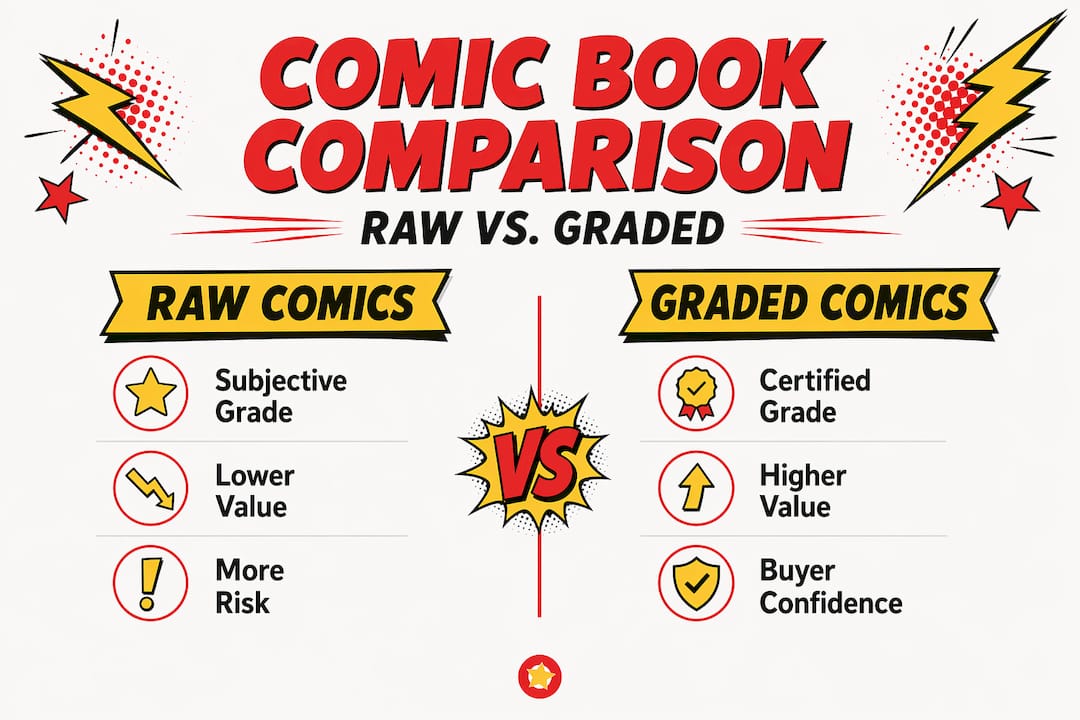
The raw market absolutely has its place. Experienced collectors who can accurately self-grade often pick up undervalued raw books and either flip them raw or grade them for a premium. That arbitrage is real. But pricing stability improves with grading because shared condition standards eliminate the back-and-forth that tanks deals.
Where does grading ROI kick in? A rough but useful rule: if the expected price increase from grading exceeds the submission fee plus selling fees, grading makes sense. Grading a raw $2,000 comic that could hit $5,000 graded easily justifies a $100 to $200 submission cost. Grading a raw $40 book that might sell for $60 graded? That math doesn’t work.
Here’s where the “9.8 cliff” thinking gets even more useful:
- A CGC 9.4 copy of a key book might sell for 30% more than raw
- A CGC 9.6 might sell for 50% to 80% more
- A CGC 9.8 can sell for 200% to 400% more than a raw copy in comparable condition
That curve is why condition going into a submission matters enormously. A book you think is a 9.8 that comes back a 9.4 may not have been worth submitting at all.
When grading is actually worth it
Not every comic deserves a slab. Here’s how to think through the decision like a serious collector:
-
Check the key issue status. First appearances, origin issues, and landmark storylines hold their value far better. Think Amazing Spider-Man #252 (first black costume) or X-Men #1 (1963). These are the kinds of books where valuation factors like rarity and demand genuinely justify grading costs.
-
Assess the book’s condition honestly before submitting. Grading a book you think is a 9.2 that comes back an 8.0 may drop its value below what you’d have gotten raw. The impact of restoration is brutal here. Restored copies can sell for just 10 to 20% of what unrestored copies fetch, and grading will flag that restoration where a raw sale might not.
-
Pull the population report. If there are already 600 copies at CGC 9.8, your slab won’t command scarcity premium pricing. Population reports are essential tools for deciding whether high-grade copies are genuinely scarce or oversupplied.
-
Consider cultural momentum. A book tied to an upcoming MCU or DCU adaptation can spike fast. Submitting early, before the wave hits, often means lower grading costs and higher eventual returns.
-
Calculate your actual ROI before you submit. Factor in the submission tier cost, return shipping, the time value of the 30 to 90 day turnaround, and eBay or platform selling fees. If the numbers still work, great. If they don’t, hold the book raw.
Pro Tip: For comics hovering in the $100 to $300 raw range, use the Zap-Kapow Comics Club platform to track high-ROI grading candidates before committing to a submission. Knowing what graded copies of the same book are currently selling for takes the guesswork out entirely.
Grading’s role in the 2026 collector market
The grading conversation has shifted significantly. This isn’t just about individual collectors protecting key books anymore. Grading is now woven into the broader economics of the hobby.
A few dynamics that are reshaping things in 2026:
- Institutional buyers are growing. Hedge funds and collectible investment firms now participate in the high-end comic market, and they will not touch raw books. Graded comics are their entry point, period.
- Online marketplaces depend on it. eBay, Heritage Auctions, and ComicLink handle massive volume through remote transactions. Slabs make those transactions possible at scale by eliminating condition disputes.
- Market downturns hit raw books harder. When comic prices cool, raw book values tend to drop faster because buyer confidence erodes and condition claims become contentious. Graded books hold value better during corrections because the grade is fixed and verifiable.
- Insurance and estate planning are now real considerations. As collections grow in value, insurance documentation and provenance tracking become practical necessities. Documented grades and serial numbers make this manageable.
For anyone watching 2026 collecting and pricing trends, graded comics are increasingly the preferred format for any book above a certain value threshold. The shift from raw-first to graded-first thinking is accelerating, not slowing down.
Our take on grading and collection strategy
We’ve watched the grading conversation evolve for years, and here’s what we’ve learned from tracking thousands of raw and graded transactions.
Grading is genuinely misunderstood. A lot of collectors still see it as paying for a plastic case and a number. What they’re actually buying is market liquidity, buyer confidence, and a certified record of condition at a specific point in time. That has real financial value, not sentimental value.
We’ve also seen collectors make costly mistakes by grading everything. Submitting a common issue just because you love it isn’t an investment strategy. Grading costs add up fast, turnaround times stretch, and a mediocre grade on a low-demand book earns you nothing.
The smartest approach we’ve seen consistently works like this: treat grading as a tool, not a default. Match submission decisions to your actual goals. If you’re building a collection for long-term appreciation, graded key issues in high grades are worth every cent. If you’re a flipper working volume, the ROI math has to pencil out book by book.
And please, always check that pop report. Scarcity at grade is what drives the real premiums, and that data is sitting right there waiting for you to use it.
Track your graded and raw values with Zap-Kapow Comics Club
Knowing why graded comics command higher prices is step one. Knowing exactly how much more your specific books are worth, right now, in real market conditions, is where the real advantage lives.
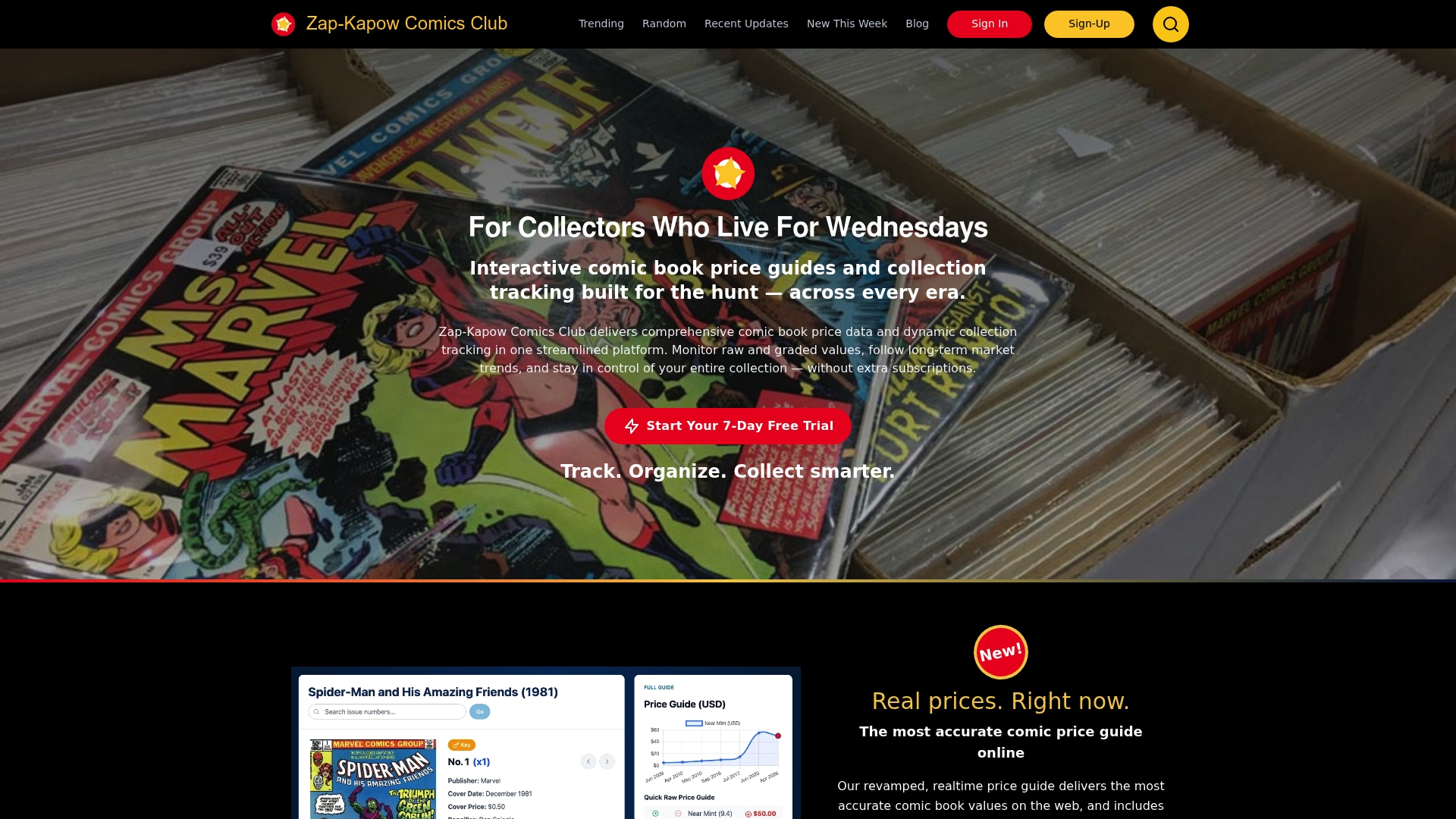
Zap-Kapow Comics Club gives you live pricing data for both raw and graded copies, long-term market trend tracking, and a full collection management platform so you can monitor your entire portfolio in one place. No juggling spreadsheets. No extra subscriptions. Whether you’re deciding which books to submit, watching for the right moment to sell, or just keeping tabs on your collection’s total value, the Zap-Kapow Comics Club platform has the data you need. Check out recent price movements to see how graded and raw values are shifting right now.
FAQ
Why do graded comics sell for higher prices than raw copies?
Graded comics carry a certified condition assessment from a trusted third party, which removes buyer uncertainty and expands the pool of confident buyers willing to pay a premium for verified quality.
What is the “9.8 cliff” in comic book grading?
The 9.8 cliff refers to the disproportionate price jump between a CGC 9.6 and a CGC 9.8. A CGC 9.8 Deadpool first appearance can sell for over $1,200 while a 9.6 of the same book sells for $400 to $500.
Are CGC graded comics worth buying as investments?
CGC graded comics worth buying for investment are typically key issues, first appearances, or culturally significant titles in grades of 9.6 or higher where the pop report shows genuine scarcity at that grade level.
How do I know if grading a comic will be worth the cost?
Compare the current raw selling price against recent graded sales for the same book at the grade you expect, then subtract grading fees and selling platform costs. If the expected resale increase clearly outpaces your total costs, submitting makes financial sense.
Does restoration affect the value of a graded comic?
Yes, dramatically. Restored copies typically sell for just 10 to 20% of what an equivalent unrestored copy commands, and CGC flags all detected restoration on the label with a purple label designation.
Recommended
- What Is Comic Book Grading? A Collector’s Guide - Zap-Kapow Comics Blog
- Raw vs. Graded: How Different Values Affect Your Collection - Zap-Kapow Comics Blog
- 10 High-ROI Comics That Are Actually Worth The Cost Of Grading - Zap-Kapow Comics Blog
- How Comic Values Are Calculated: Rarity, Demand and Trends Explained - Zap-Kapow Comics Blog