
Tracking comic market trends is the practice of monitoring sales data, guide values, grading census reports, and collector behavior to make informed decisions about buying, selling, and valuing comics. The global comic book market was valued at $19.05 billion in 2025 and is projected to reach $37.15 billion by 2033, growing at a CAGR of 8.9%. That kind of growth means real money is moving through this hobby, and collectors who ignore market signals are leaving value on the table. Zap-Kapow Comics Club gives collectors the price data and collection tracking tools to stay on top of it all, without juggling multiple subscriptions.
What data sources are best for tracking comic market trends?
The most reliable data for comic book market analysis comes from four core sources: recent sold listings, price guides, population reports, and auction results. Each one tells a different part of the story, and using only one is like reading a comic with half the pages missing.
Recent sold listings (primarily from eBay’s completed sales) show what collectors actually paid, not what sellers hoped to get. Guide values summarize a potential range of worth, but recent sold listings are the only true measure of current market demand. When guides and sold data diverge, trust the sales. That gap is where collectors either find bargains or avoid overpaying.

Population reports from grading services like CGC and CBCS track how many copies of a book exist at each grade tier. A book with only three copies graded 9.8 behaves very differently in the market than one with 3,000. Population data is your supply-side signal.
Auction results from major houses add another layer, especially for high-value keys. These realized prices often set the ceiling for what the market will bear on a given issue.
| Data source | Primary purpose | Reliability | Best used for |
|---|---|---|---|
| eBay sold listings | Current demand | High | Raw and graded recent comps |
| Price guides | Baseline reference | Moderate | Starting point, not final word |
| Grading census | Supply visibility | High | Scarcity and grade distribution |
| Auction results | High-value benchmarks | High | Key issues and major keys |
| Active listings | Seller sentiment | Low | Context only, not valuation |
Pro Tip: Cross-reference at least three data sources before assigning a value to any book. One source alone can mislead you, especially in fast-moving markets where guides lag behind actual sales by months.
For a deeper breakdown of how these sources stack up, the comic valuation methods guide on Zap-Kapow Comics Club walks through each approach with collector-focused examples.
How do key factors drive comic book market trends and values?
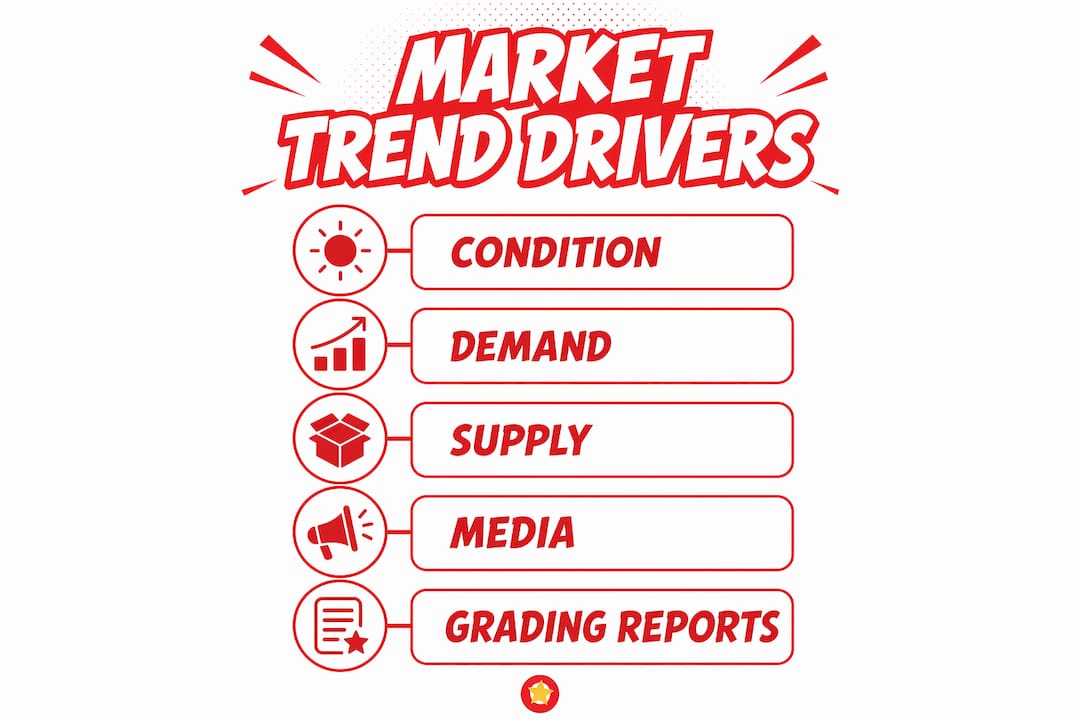
Comic book market trends explained simply: values move when condition, demand, and supply shift. Understanding which factor is driving a move helps you tell a real trend from a temporary spike.
Condition and grading
Grade tiers create price cliffs, not gradual slopes. A book graded 9.6 might sell for $200, while the same issue in 9.8 sells for $800. That gap exists because collectors chase the top of the population report. When a new batch of high-grade copies surfaces through a collection find, it can reset the ceiling for an entire issue overnight. Monitoring factors affecting comic book value keeps you aware of these grade-driven swings.
Demand catalysts
Media announcements, casting news, anniversaries, and franchise momentum serve as demand catalysts, raising attention and sometimes driving temporary spikes in comic values. A first appearance of a character cast in an upcoming film can triple in price within 48 hours of the announcement. The key word is “temporary.” Some spikes hold; many fade once the initial excitement cools.
Supply and genre trends
Global comic book market growth is supported by manga popularity, digital subscription adoption, and the integration of comic IP into broader entertainment industries. The digital comics segment is projected to grow rapidly due to convenience and accessibility, complementing sustained demand for print comics in collector communities. Manga and digital formats are primary growth drivers for sustained market expansion, while superhero franchises remain vital to global readership.
Top comic market trend indicators to watch:
- CGC and CBCS census changes for key issues at top grade tiers
- eBay 90-day sold averages versus 30-day sold averages (divergence signals momentum)
- Film and streaming announcements tied to specific characters or titles
- Publisher market share shifts (in Q1 2026, DC held 34.7% versus Marvel’s 29.4%)
- Print run data and variant cover counts for modern books
- Manga series completion announcements, which often spike collected edition prices
How to track comic book values step by step
A repeatable process beats gut instinct every time. Here is a practical method for monitoring comic sales and keeping your valuations current.
Step 1: Build your inventory with condition bands. Log every book with its title, issue number, grade (raw or certified), and key issue status. Group books into tiers: high-grade keys, mid-grade readers, and raw common stock. This structure makes it easy to prioritize which books need active monitoring.
Step 2: Pull recent sold comps. Search eBay’s completed listings filtered to the last 90 days. Record the low, median, and high sale prices for your grade tier. Three data points give you a range; one data point gives you a guess.
Step 3: Factor in all costs. Auction commissions run 10%–25%, plus shipping, insurance, and grading fees reduce net proceeds significantly. A book that sold for $500 at auction might net $350 after all costs. Build those deductions into your value estimate before making any sell decision.
Step 4: Apply a 36-month sales view for cycle timing. A 36-month sales view helps filter noise and identify true market cycles versus short-term spikes. A book that spiked after a movie announcement but returned to its pre-announcement price within six months was never a trend. It was a moment.
| Step | Action | What it tells you |
|---|---|---|
| 1. Inventory | Log title, grade, key status | Baseline for tracking changes |
| 2. Sold comps | 90-day eBay completed sales | Current market demand |
| 3. Cost factoring | Subtract fees, shipping, grading | Realistic net value |
| 4. Cycle view | 36-month sales history | True trend vs. noise |
| 5. Update trigger | Reassess after major news or 90 days | Keeps valuations current |
Pro Tip: Keep a simple spreadsheet with a “last updated” column and a “trigger” column. Log what caused each valuation change, whether it was a film announcement, a census update, or a new high sale. Over time, you will spot which triggers actually move your specific books.
For more on cross-referencing sold prices, Zap-Kapow Comics Club has a dedicated guide that walks through the comp process in detail.
How do you spot and interpret shifts in comic market cycles?
Comic market cycles follow recognizable patterns once you know what to look for. A bull phase brings rising sold prices, shrinking supply of high-grade copies on the market, and increasing bid competition. A bear phase shows the opposite: more copies listed, longer time to sell, and declining realized prices.
The single biggest mistake in comic market cycle timing is confusing active listing prices with actual demand. A seller listing a book at $1,000 does not mean the market supports $1,000. Only a completed sale confirms that. Relying on active asking prices rather than realized sold prices is the most common error collectors make when reading trends.
Cultural and entertainment signals drive the most dramatic short-term cycles. Streaming adaptations, in particular, have a pattern: prices spike on announcement, peak around release, and often correct within three to six months unless the adaptation is a genuine hit. The story of how every IP now has a second life online means more characters are getting adapted than ever, which creates more of these short cycles to navigate.
Common mistakes in trend interpretation and how to avoid them:
- Trusting asking prices over sold prices. Always filter to completed sales, not active listings.
- Ignoring the census. A spike in high-grade submissions can flood supply and drop prices fast.
- Overweighting one sale. A single outlier sale does not set the market. Look for three or more recent comps.
- Missing regional factors. Some books command premiums in specific markets. International sold data can skew averages.
- Chasing the spike. Buying after a media announcement usually means buying at the peak, not ahead of it.
- Ignoring print format trends. Digital growth does not kill print demand in collector circles, but it does affect which titles get collected versus read digitally.
Staying current on 2026 collecting and pricing trends helps collectors recognize these patterns before they get caught on the wrong side of a cycle.
Key Takeaways
Tracking comic market trends requires combining sold data, census reports, and demand signals into a repeatable process that keeps collection valuations accurate and buying decisions grounded in real market evidence.
| Point | Details |
|---|---|
| Sold data beats guide values | Recent eBay completed sales reflect true demand; guides lag and should only be a starting point. |
| Factor in all costs | Auction fees of 10%–25% plus shipping and grading reduce net returns significantly. |
| Use a 36-month view | A three-year sales history separates genuine market cycles from short-term media-driven spikes. |
| Watch demand catalysts | Film announcements and streaming adaptations create predictable price spikes that often correct post-release. |
| Census data is supply intelligence | Rising high-grade populations can deflate prices; falling supply at top grades supports value growth. |
Our take on disciplined comic market tracking
We have seen collectors treat valuation as a one-time event, something you do when you buy a book and then forget about. That approach works fine in a stable market. The comic market in 2026 is not stable. It is active, media-driven, and increasingly global, with manga and digital formats pulling new collectors in every month.
The collectors who protect and grow their collections are the ones who treat tracking as an ongoing practice. They check sold comps quarterly. They watch the census after major grading submissions. They note when a character gets cast and decide in advance whether they will buy ahead of the announcement or sit it out.
Combining objective data with community insights matters too. What the numbers show and what experienced collectors are discussing in forums often point in the same direction before the data fully confirms it. Neither source alone is enough.
Maintaining a disciplined valuation method that includes condition, sales comps, and fees leads to confident collecting and informed selling. That confidence is what separates collectors who build real value from those who just accumulate boxes.
Zap-Kapow Comics Club integrates price data, collection tracking, and trend monitoring in one place, which makes the ongoing practice of tracking far less of a chore and a lot more like the fun part of collecting.
Zap-Kapow Comics Club and your collection’s market edge
Staying on top of comic book market analysis is a lot easier when your tools do the heavy lifting. Zap-Kapow Comics Club tracks raw and graded values, monitors long-term price trends, and keeps your entire collection organized without requiring a stack of separate subscriptions.
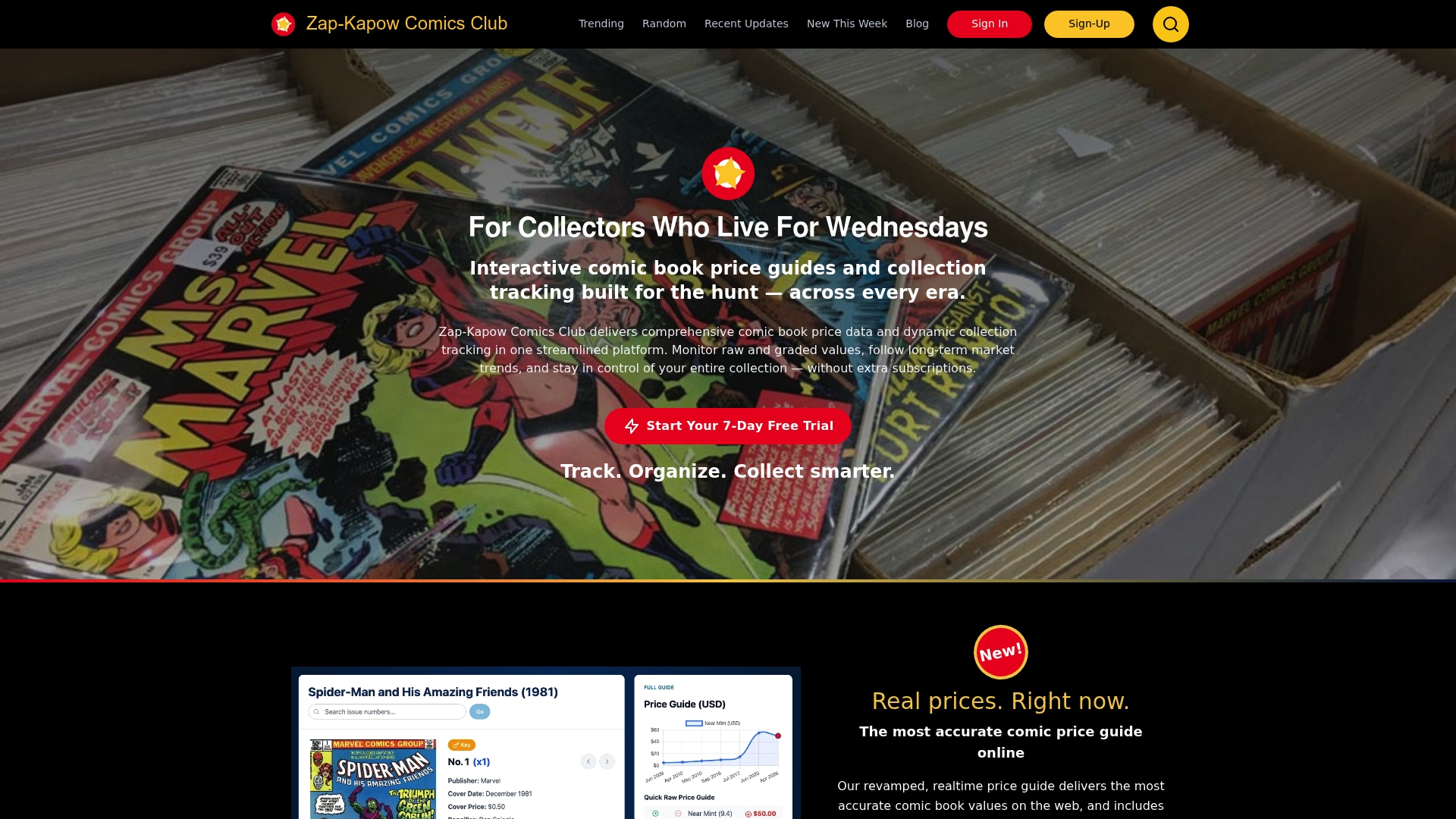
The trending comic book titles page on Zap-Kapow Comics Club updates regularly, giving collectors a live view of which books are moving and which are cooling off. Whether you are watching a key issue climb or deciding when to sell, having current data in one place makes the call easier. Zap-Kapow Comics Club is built for collectors who take their collections seriously and want the market intelligence to back up every decision they make.
FAQ
What does tracking comic market trends actually mean?
Tracking comic market trends means monitoring recent sold prices, grading census data, and demand signals like media announcements to understand how comic values are moving. It is an ongoing practice, not a one-time check.
Are price guides reliable for comic book market analysis?
Price guides are useful starting points but often lag behind actual market conditions. Recent sold listings on platforms like eBay are the most reliable measure of current demand.
How often should collectors update their comic valuations?
Collectors should review valuations every 90 days at minimum, and immediately after major news events like film announcements or significant auction results that affect their specific books.
What is the best way to spot a real trend versus a short-term spike?
A 36-month sales view helps separate genuine market cycles from short-term spikes. If prices return to pre-event levels within a few months, the move was a spike, not a trend.
How do grading census reports affect comic book values?
Census reports track the number of copies graded at each tier. When high-grade populations rise sharply, supply increases and prices can fall. Shrinking top-grade supply typically supports higher values.
Recommended
- 10 Comic Book Collecting & Pricing Trends to Watch in 2026 - Zap-Kapow Comics Blog
- Hidden Gems: 5 Comics Quietly Gaining Value — May 2026 - Zap-Kapow Comics Blog
- Hidden Gems: 4 Comics Quietly Gaining Value — June 2026 - Zap-Kapow Comics Blog
- Zap-Kapow Comics Club - Price Guide and Collection Management