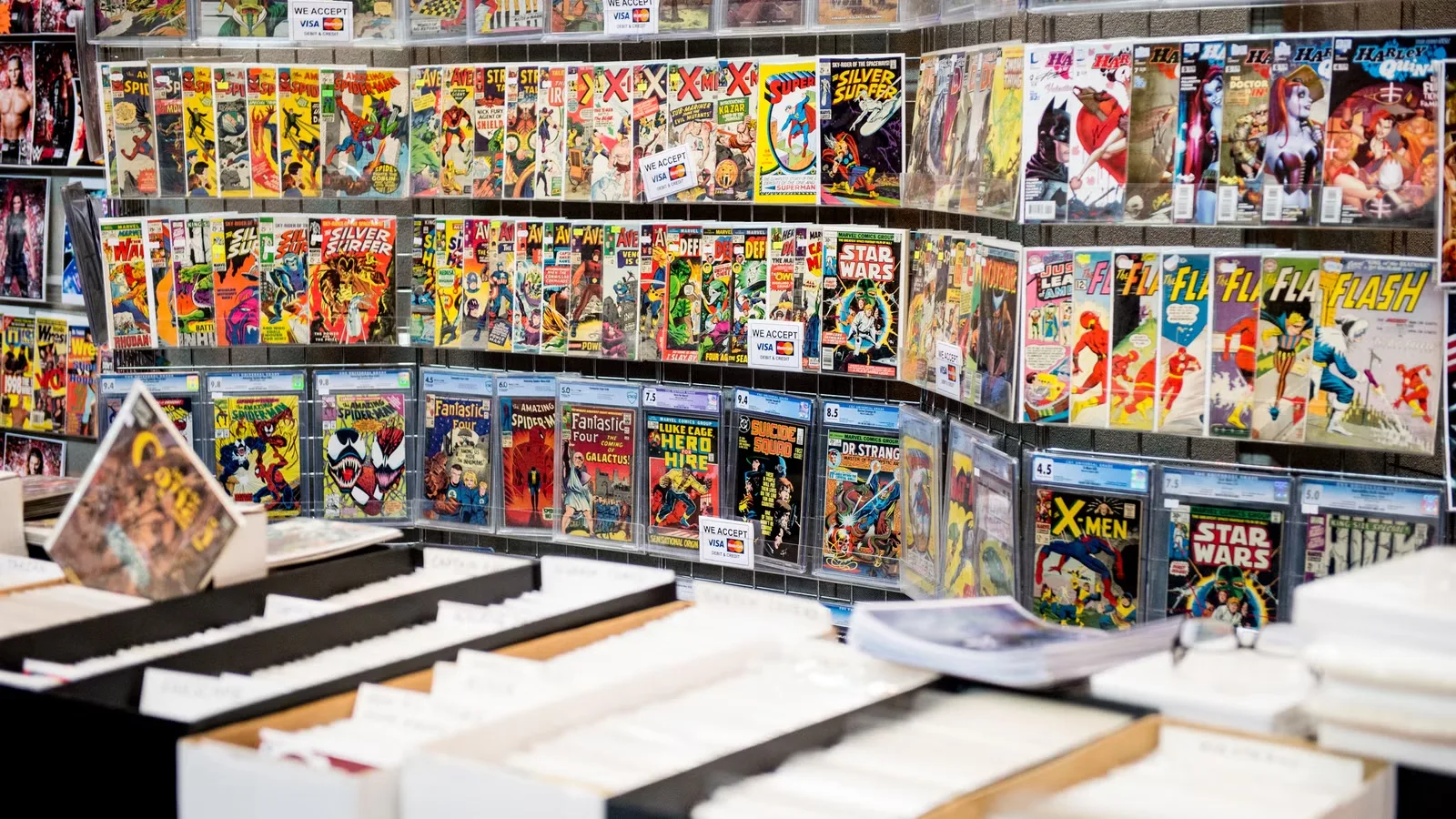
Selling comic books at the highest price is defined by three factors: professional grading, smart channel selection, and real-time market timing. The record proves the ceiling is extraordinary. A CGC 9.0 copy of Action Comics #1 sold for $15 million in a private sale in 2026, while Batman #1 CGC 9.4 and Superman #1 CGC 8.5 together fetched $13 million in the same period. Those numbers aren’t flukes. They reflect a market where condition, authentication, and platform choice separate a life-changing sale from a disappointing one. Whether you’re moving a single key issue or an entire collection, this guide gives you the exact playbook to maximize comic book sales in 2026.
How does comic book grading affect the highest sale prices?
Comic book grading is the process of having a third-party professional evaluate a book’s condition and seal it in a tamper-evident case with a numeric grade. The three dominant grading companies are CGC (Certified Guaranty Company), CBCS (Comic Book Certification Service), and PGX (Professional Grading Experts). CGC holds the strongest brand recognition among collectors and typically commands the highest price premiums at auction.
Grades run from 0.5 to 10.0, and the price difference between grades is not linear. It’s exponential. A CGC 9.8 copy of a Silver Age key can fetch three to five times more at auction than a direct buyer’s offer for the same book in lower grade. That multiplier effect is why serious sellers treat grading as an investment, not an expense.
Graded comics command higher prices because the grade functions as trusted proof of condition for buyers who can’t physically inspect the book. Without that third-party verification, buyers discount their offers to account for uncertainty. An ungraded copy of a key issue will almost always sell for less than its graded equivalent, even when the raw condition appears identical.
Here’s what grading does for your sale price in practical terms:
- CGC 9.8 vs. 9.6: Even a half-point difference on high-demand keys can represent thousands of dollars in price separation.
- Slabbed vs. raw: Graded books attract institutional buyers, auction houses, and serious collectors who won’t touch unverified copies.
- Census data: The CGC census shows how many copies exist at each grade. A book with only two copies at 9.8 is a genuinely scarce asset, and buyers pay accordingly.
- Provenance and pedigree: Books from recognized collections (like the Edgar Church/Mile High collection) carry additional premiums even within the same grade.
Pro Tip: Before submitting to CGC or CBCS, check the CGC census for your specific issue. If dozens of 9.8 copies already exist, the grade premium shrinks. If the census shows only a handful, grading could multiply your sale price dramatically.
For a deeper look at how grades translate to dollars, the factors affecting comic book value guide from Zap-Kapow Comics Club breaks down rarity, condition, and demand in detail.
What are the best places to sell comics for maximum profit?
The best place to sell comic books depends entirely on what you’re selling and how much time you’re willing to invest. No single channel wins every scenario. Here’s how the main options stack up.
Auction houses
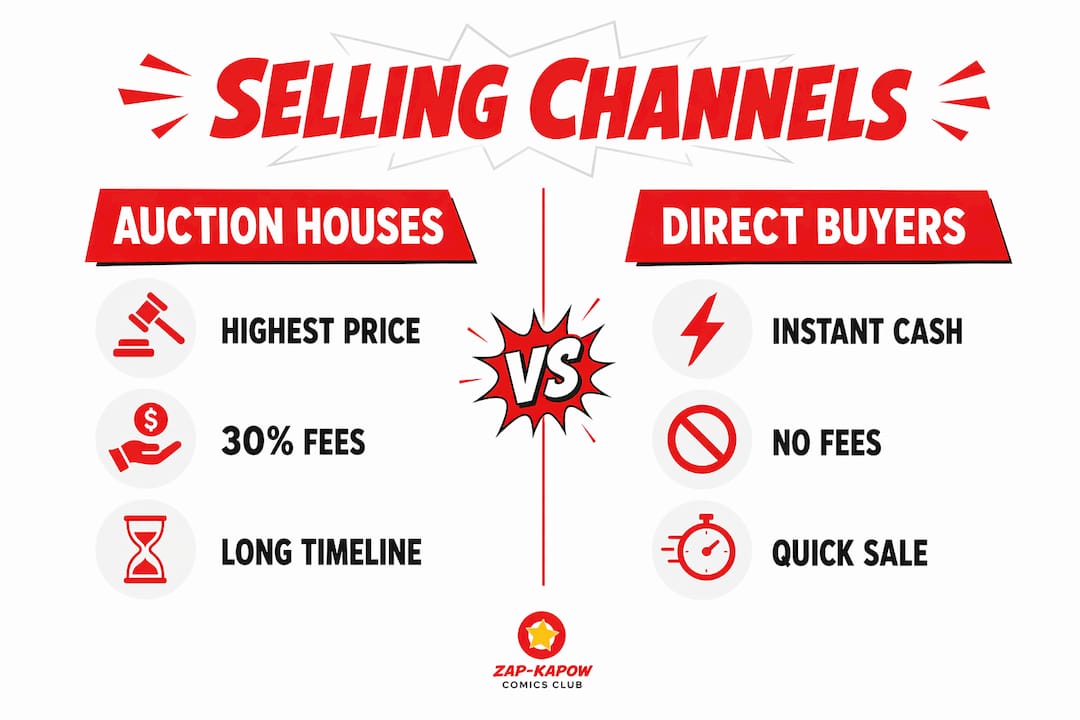
Heritage Auctions and ComicConnect are the two dominant players for high-value comics. Heritage in particular has brokered some of the most significant sales in the hobby’s history. Auction houses reach the largest pool of serious, deep-pocketed collectors, which drives competitive bidding and peak prices for key issues.
The catch is fees. Auction house premiums from combined buyer’s and seller’s fees can exceed 30% of the hammer price. That means a book that hammers at $10,000 might net you $7,000 or less after the house takes its cut. You also wait. Consignment cycles, catalog deadlines, and auction schedules mean months can pass before your book sells.
Direct buyers
Direct buyers like Sparkle City Comics offer instant cash with no waiting, no fees, and no logistics headaches. They handle evaluation, shipping, and payment on a fast timeline. The tradeoff is price. Direct buyers pay wholesale rates, not retail or auction peak. For large, varied collections where grading every book individually would cost more than the gain, direct buyers often represent the smartest, fastest strategy.
Online marketplaces
eBay remains the highest-traffic marketplace for comics at every price point. MySlabs is a newer platform built specifically for graded comics, with a collector-focused audience and lower fees than eBay. The audience size on eBay is unmatched, but fees (typically 12 to 15% combined with PayPal or payment processing) eat into margins.
| Channel | Price potential | Speed | Effort | Best for |
|---|---|---|---|---|
| Heritage / ComicConnect | Highest | Slow (months) | Low (consignment) | Key issues, high-grade slabs |
| Direct buyers | Lowest | Fastest (days) | Lowest | Large collections, mixed grades |
| eBay | High | Medium (weeks) | High | Mid-range keys, graded books |
| MySlabs | High | Medium | Medium | Graded Silver and Bronze Age |
The right channel isn’t always the one with the highest ceiling. Selling collections piecemeal can be time-consuming, and storage costs, grading fees, and market fluctuations can quietly erase the theoretical gains from individual sales. Know your priorities before you commit.
How to use market data and timing to maximize sale prices
Top sellers treat pricing as a live activity, not a one-time decision. Dynamic pricing using real-time market data rather than static price guides is the single biggest differentiator between sellers who leave money on the table and those who don’t. Here’s how to do it right.
- Check recent eBay sold listings first. Filter by “sold” on eBay for your specific issue, grade, and certification company. Completed sales from the last 30 days are your most accurate price anchor. Ignore asking prices. Only closed sales reflect what buyers actually paid.
- Cross-reference the CGC census. CGC census and sales velocity data tell you how many copies exist at your grade and whether submission rates are rising. A flood of new 9.8 submissions can soften prices fast.
- Time listings around collector events. San Diego Comic-Con, New York Comic Con, and major Marvel or DC film announcements reliably spike demand for related keys. A first appearance of a character getting a movie debut can double in value overnight.
- Use condition-tiered bundling. If you have multiple copies of the same issue at different grades, bundle the lower grades together as a lot. Buyers who can’t afford the 9.8 will pay a fair premium for a curated 7.0 to 8.5 lot with clear photos and honest descriptions.
- Factor fees before you set your floor price. Auction fees exceeding 30%, eBay’s combined fees, and shipping costs all reduce your net. Calculate your actual take-home before listing, not after.
Pro Tip: Embed value justification directly in your listing description. Reference the CGC census population, link to recent comparable sales, and include verified slab photos from multiple angles. Buyers pay more when they feel confident, and confidence comes from transparency.
Step-by-step process to prepare and sell your comics for top dollar
Getting the highest possible price isn’t accidental. It follows a repeatable process. Here’s the roadmap we recommend for sellers serious about maximizing their returns.
Step 1: Organize and identify your key issues. Sort your collection by era, publisher, and issue number. Flag first appearances, origin issues, and low-print variants. These are your highest-value candidates and deserve individual attention.
Step 2: Assess raw condition honestly. Before spending money on grading, evaluate each book’s spine stress, page quality, and cover gloss. Books with obvious defects (tears, writing, water damage) rarely grade high enough to justify CGC fees. Be ruthless here.
Step 3: Submit high-value candidates to CGC or CBCS. For any book you believe can grade 8.0 or higher and has a raw value above $100, professional grading almost always pays for itself. Use CGC’s modern tier for books valued under $400 and economy tier for higher-value submissions to manage turnaround time.
Step 4: Select your platform based on the book’s value and your timeline. Use the comparison table above as your guide. High-grade keys go to Heritage or ComicConnect. Mid-range graded books go to eBay or MySlabs. Mixed or lower-grade collections go to direct buyers.
Step 5: Build listings with verified photos and market context. Photograph every slab from the front, back, and label. Include the CGC census population in your description. Reference recent comparable sales. Set your opening bid or buy-it-now price based on actual sold data, not hope.
Step 6: Handle offers and close with confidence. Counter low offers with data, not emotion. “The last CGC 9.6 of this issue sold for $X on [date]” is more persuasive than any argument. For auctions, set a realistic reserve and let competitive bidding do the work.
Step 7: Ship professionally. Use rigid mailers for raw books and bubble wrap plus a sturdy box for slabs. Insure everything above $50. A damaged book in transit is a refund, a dispute, and a destroyed reputation.
| Step | Action | Tool or resource |
|---|---|---|
| Identify keys | Sort by first appearances and variants | CGC census, Zap-Kapow Comics Club |
| Grade assessment | Evaluate raw condition | Personal inspection, grading guides |
| Professional grading | Submit to CGC or CBCS | CGC.com, CBCS.com |
| Platform selection | Match book value to channel | Comparison table above |
| Listing creation | Photos, census data, sold comps | eBay, MySlabs, Heritage |
| Shipping | Rigid mailers, insurance | USPS, UPS, FedEx |
Our take on selling comics for top dollar in 2026
The comic book market in 2026 rewards sellers who treat their collection like an asset portfolio, not a pile of old magazines. We’ve seen too many collectors leave serious money behind by rushing to sell without grading, skipping fee calculations, or listing on the wrong platform for their specific books.
The biggest shift we’re watching right now is the growing role of real-time data. Sellers who check eBay sold comps daily and monitor CGC census submission trends are consistently outperforming those who rely on printed price guides or gut instinct. The market moves fast, and static pricing is a losing strategy.
We also want to be honest about the patience required for auction success. Heritage and ComicConnect can absolutely deliver record prices, but the timeline is real. If you need cash in 30 days, a direct buyer is the right call even at a lower price. There’s no shame in that trade-off. Knowing your own priorities is part of selling smart.
One underrated tactic: transparency builds trust, and trust builds price. Sellers who include CGC census data, provenance notes, and honest condition descriptions in their listings consistently close at higher prices than those who post a single photo and a vague description. Buyers pay a premium for confidence.
The collectors who win in this market combine the patience to wait for the right auction slot, the discipline to grade strategically, and the data literacy to price based on what the market is actually doing today.
Key takeaways
Selling comic books at the highest price requires grading, channel selection, and real-time pricing working together as a system.
| Point | Details |
|---|---|
| Grading multiplies value | CGC 9.8 slabs can fetch three to five times more than direct buyer offers for the same book. |
| Channel choice determines net price | Auction houses offer peak prices but take 30%+ in fees; direct buyers pay less but settle fast. |
| Dynamic pricing beats static guides | Use recent eBay sold data and CGC census figures to anchor every listing price. |
| Timing drives demand spikes | List key issues around conventions and film announcements to catch collector demand surges. |
| Piecemeal vs. bulk requires honest math | Grading costs, storage, and time can erase individual sale gains; bulk sales often win on net. |
How Zap-Kapow Comics Club helps you sell for top dollar
Knowing the right price is half the battle. Zap-Kapow Comics Club gives you the data to win the other half.
Zap-Kapow Comics Club tracks both raw and graded values across thousands of titles, so you always know what your books are worth before you list them anywhere. The price guide and collection tools update with market trends, letting you spot the right moment to sell rather than guessing. You can also monitor trending comic titles to catch demand surges before they peak. No extra subscriptions, no scattered spreadsheets. Just clean, current data that puts you in control of every sale. Join Zap-Kapow Comics Club and stop leaving money on the table.
FAQ
What is the highest price ever paid for a comic book?
A CGC 9.0 copy of Action Comics #1 sold for $15 million in a private sale in 2026, making it the current record holder for the highest comic book sale price.
Does grading always increase a comic book’s sale price?
Grading increases sale price when the book grades high enough to justify the submission fee. Books that grade below 6.0 on low-demand titles rarely recoup grading costs, so assess raw condition honestly before submitting.
What are the best places to sell high-value comic books?
Heritage Auctions and ComicConnect are the top platforms for key issues and high-grade slabs. eBay and MySlabs work well for mid-range graded books, while direct buyers are best for large or mixed-grade collections.
How do auction house fees affect my net proceeds?
Combined buyer’s and seller’s premiums at major auction houses can exceed 30% of the hammer price. A book that sells for $10,000 at auction may net you $7,000 or less after fees, so always calculate your take-home before consigning.
How do I price a comic book accurately in 2026?
Use recent completed eBay sales filtered by grade and certification company as your primary price anchor. Cross-reference the CGC census for population data, and adjust your price based on how many copies exist at your grade.
Recommended
- How to Sell Your Comic Book Collection for Top Dollar: 5 Tips to Maximize Profit - Zap-Kapow Comics Blog
- 10 Comic Book Collecting & Pricing Trends to Watch in 2026 - Zap-Kapow Comics Blog
- Top 10 Most Valuable Comic Books From The 2000’s - Zap-Kapow Comics Blog
- Hidden Gems: 4 Comics Quietly Gaining Value — June 2026 - Zap-Kapow Comics Blog