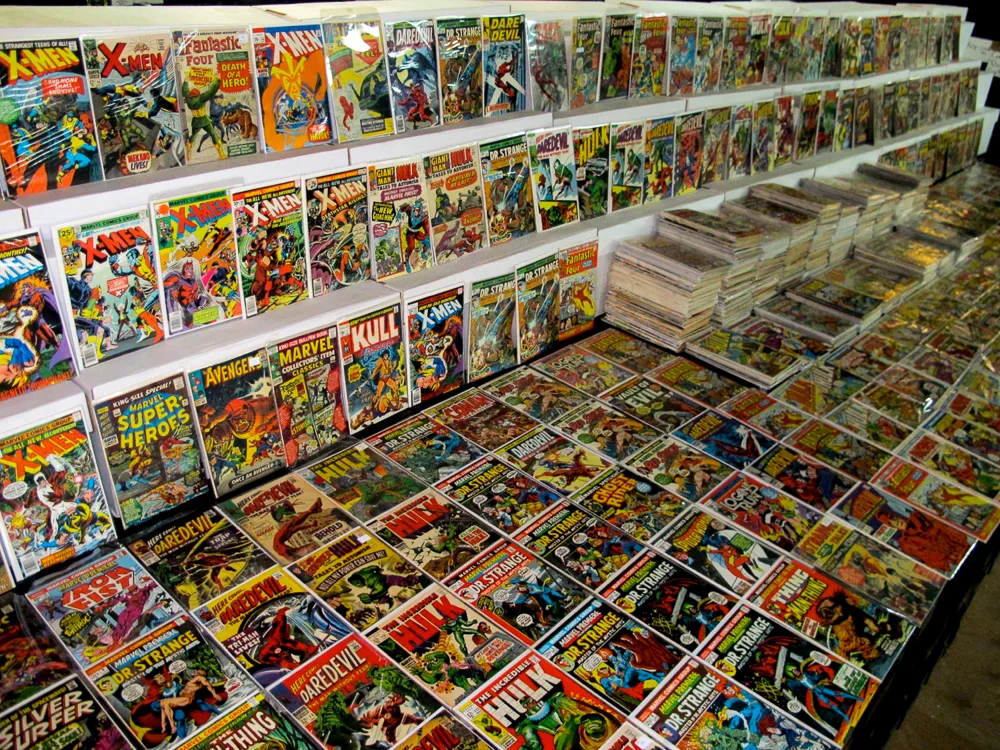
Sell when buyer demand for your specific books lines up with documented condition and your own reason for cashing out. That means checking whether a movie announcement or fresh sold listings are pushing your issues upward, confirming your books are in the shape you think they are, and being honest about whether you need the cash or the closet space right now. If two of those three line up, you’re in a good position to sell. If none of them do, hang onto your longboxes a little longer.
TL;DR:
- Media production news, multiple recent high-priced sold listings, and increasing grading submissions signal a sustained demand spike for specific key comics.
- Selling raw individual issues in good condition usually yields higher returns than grading unless the expected premium significantly outweighs fees.
- Using detailed inventory documentation, professional photos, and provenance reduces buyer hesitation and increases final sale prices.
- Selling through auction houses can surpass retail prices for rare high-grade keys, but involves longer waits and higher seller fees compared to dealer or online sales.
- Tracking real market prices via dedicated tools helps time sales effectively and avoid reliance on uncertain asking prices or social media rumors.
Table of Contents
- Market Signals: How to Tell If Right Now Is a Good Time to Sell Comics
- How Condition and Grading Affect Timing and Value
- How Should You Prepare Your Collection Before Listing?
- Where Should You Sell Your Comics: Dealer, Auction, or Online?
- What Should You Expect to Get Paid, and How Long Will It Take?
- How Zap-Kapow Comics Club Helps You Time and Document a Sale
- Our Take: A Practical Checklist for Deciding to Sell Now
- An Alternative to Guesswork: Track Prices With Zap-Kapow Comics Club
- Sources
- FAQ
Market Signals: How to Tell If Right Now Is a Good Time to Sell Comics
Comic values don’t move in a straight line, and the trick to catching a wave instead of a ripple is knowing where to look. Media adaptations are the biggest lever in the modern market. A trailer drop, a casting announcement, or a confirmed release date for a Marvel or DC project routinely sends the first-appearance issue tied to that character climbing within days. The catch is separating a real trend from a flash spike.
Start with actual transaction data, not asking prices. Filter eBay listings by “sold,” check auction house results, and cross-reference against a price-tracking tool before you assume your book is worth what a random listing claims. Asking prices lie. Sold prices don’t.
Seasonality matters too. Convention season and spring tend to bring more buyers into the market, which increases both listing velocity and price realization compared to the slower winter months. But watch for the flip side: when a key issue suddenly floods the market because everyone had the same idea, prices flatten fast.
Signs that a demand spike has legs, not just hype:
- Multiple sold listings at the higher price over several weeks, not a single lucky auction
- Confirmed media production news (not just fan rumors or social media speculation)
- Grading submission volume climbing for that specific issue
- Dealers actively restocking that title instead of sitting on existing copies
Pro Tip: If you see a spike right after a casting announcement, wait two to three weeks before listing. That’s usually long enough to tell whether the market is settling into a new, higher price or snapping back to normal.
How Condition and Grading Affect Timing and Value
Condition is still the single biggest lever on what your comic actually fetches, full stop. Two copies of the same issue can sell for wildly different amounts depending on spine roll, staple rust, color breaks, and page tone. Off-white or browning pages knock value down even on an otherwise clean book, and a lot of sellers don’t realize that until a buyer points it out and lowballs them.
Grading isn’t automatically worth it. The rule dealers use is simple: only submit a book for professional grading when the expected grade premium clearly outweighs the grading, shipping, and insurance costs. For most modern comics valued under roughly $100 raw, that math rarely works out.
Quick checks before you decide:
- Look at the spine under raking light for stress lines or rolling
- Check staples for rust bleed into the surrounding paper
- Fan the pages gently to spot tears or interior creasing
- Compare your copy against CGC, CBCS, and PGX standards to estimate a likely grade range
Never attempt amateur restoration. Pressing, cleaning, or re-gluing a book yourself almost always tanks its value once a buyer or grader spots it, and undisclosed repairs are a fast way to torch your reputation as a seller.
How Should You Prepare Your Collection Before Listing?
Buyers pay less when they smell risk. Documentation is how you kill that risk before it kills your price.
- Build an inventory sheet with title, issue number, publisher, printing (first print matters), approximate purchase date, and detailed condition notes for each book.
- Photograph every key issue from the front cover, back cover, spine, and any known defect, using consistent lighting and clear file names like “ASM129_front.jpg.”
- Note provenance if you have it, including where the book came from and how long you’ve owned it, since traceable history reduces buyer hesitation.
- Pack carefully for shipping, using a bag, board, and rigid mailer, and insure anything worth more than $75.
- Test the market with your best key first rather than dumping the whole collection at once, so you learn what a fair offer actually looks like before you commit the rest.
A tidy digital record with sharp photos turns a nervous dealer offer into something closer to full retail, because it removes the guesswork that usually costs you money.
Where Should You Sell Your Comics: Dealer, Auction, or Online?
The right channel depends entirely on what you’re selling and how fast you need the money. A local dealer gets you paid the same day but at a lower percentage. An auction house can post record numbers for a rare, high-grade key, but you’ll wait weeks or months and pay seller fees. eBay puts your book in front of the widest pool of buyers, though it takes real effort to list, photograph, and ship correctly. Dedicated comic marketplaces and consignment shops split the difference, connecting you with buyers who already collect that specific title.
| Channel | Best for | Typical payout | Speed |
|---|---|---|---|
| Local dealer | Bulk lots, quick cash | 40 to 60% of retail (higher for standout keys) | Same day to a few days |
| Auction house | High-grade rare keys | Can exceed retail for top condition | Weeks to months |
| eBay | Individual key issues | Near retail minus fees and shipping | Days to weeks |
| Dedicated platforms/consignment | Targeted collector buyers | Mid to high retail range | 1 to 4 weeks |
| Conventions/local marketplaces | Fast, reader-focused sales | Varies widely | Same day |
Those dealer payout ranges hold true across most regional shops, since a Florida-based dealer’s own breakdown of bulk versus single-key pricing lines up with what collectors report nationwide.
A few decision rules worth remembering:
- Sell raw if the book is common or modern; grade first only if it’s a legitimate key in strong shape.
- Consign through a shop or platform when you want expert listing help; sell yourself when you want to keep the full margin.
- Match the book to the channel: eBay and dedicated comic platforms work best for individual key issues, while auctions suit the rare, high-grade showpieces.
Piloting a small batch, maybe one to five keys, across two different channels gives you a real read on where the rest of your collection will net the best average return.
What Should You Expect to Get Paid, and How Long Will It Take?
Set your expectations before you list anything, because the gap between what a book is “worth” and what actually lands in your account can be wide. Dealers typically offer 40 to 60% of retail on bulk lots, with strong individual keys sometimes reaching 70% or more. Auctions can beat that ceiling entirely for a graded rarity. Heritage Auctions has set world-record prices for ultra-high-grade keys, proving just how far the top end can stretch when the right book meets the right bidder.
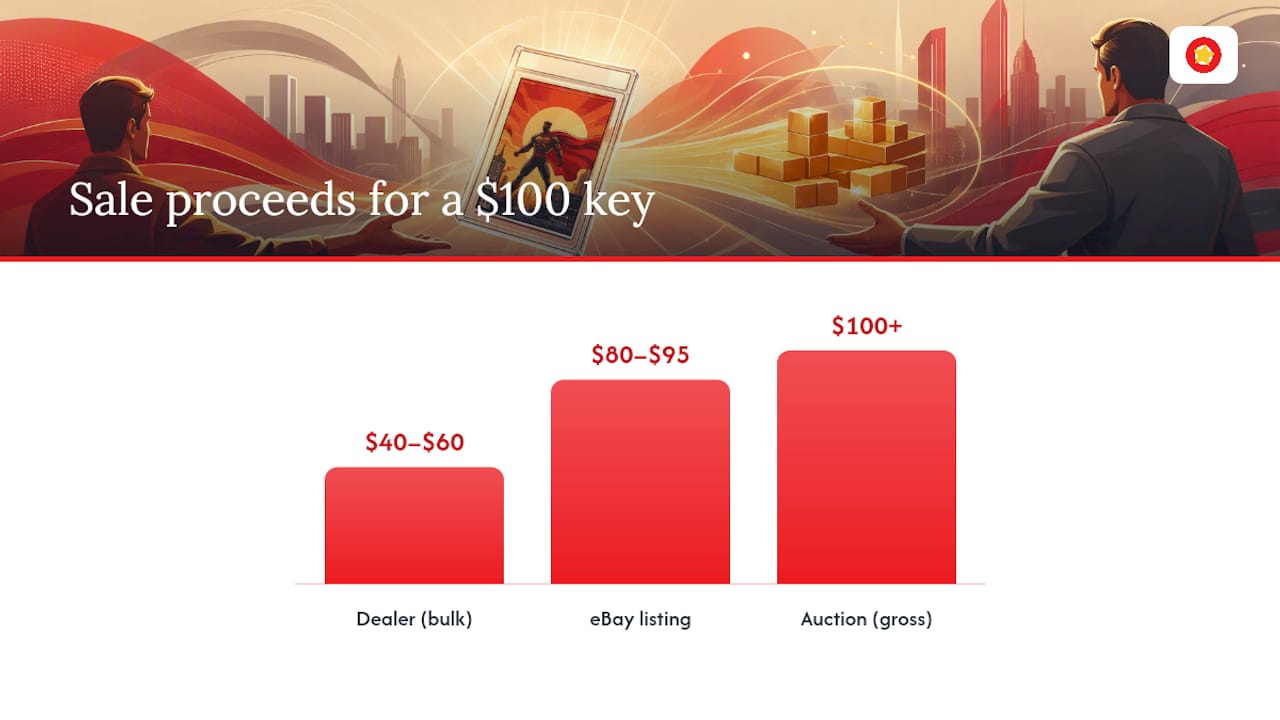
Here’s a rough worked comparison for a $100 key issue:
- Dealer sale: roughly $40 to $60 same day, no fees, no waiting
- eBay listing: $80 to $95 after fees and shipping, typically within one to three weeks
- Auction consignment: potentially $100 or more, but expect a 15 to 20% seller commission and a wait of one to three months
Common modern issues sold in bulk to a dealer often bring only cents per copy, so don’t expect meaningful cash from a stack of duplicate 2020s titles. Save the effort for your genuine keys.
How Zap-Kapow Comics Club Helps You Time and Document a Sale
Timing a sale well means watching price history, not just guessing off a gut feeling. A price tracking and collection management platform tracks raw and graded values over time, flags trend shifts, and keeps your collection organized in one spot instead of scattered across spreadsheets and sticky notes.
Practical uses look like this: spot a demand uptick on a title before it hits mainstream news, generate a clean itemized inventory to hand a dealer or attach to a listing, and document provenance details that reduce the buyer-risk discount dealers otherwise build into their offers. It won’t list your book for sale or process a transaction. Think of it as the research and record-keeping layer that makes every other step in this article faster and more accurate.
Our Take: A Practical Checklist for Deciding to Sell Now
We’d boil this whole decision down to three questions: Is demand for this specific book real and sustained? Is the condition documented, not guessed at? Do you actually need the money or the space? If you can answer yes to two of three, list it.
For urgent sellers: get an itemized inventory together today, and get at least one dealer quote before you commit anywhere. For sellers who can wait: track sold prices for a few weeks, and consider a professional opinion before grading anything borderline. Skip the amateur restoration urge entirely, and confirm the grading premium actually beats the fees before you submit a single book.
— Steve
An Alternative to Guesswork: Track Prices With Zap-Kapow Comics Club
There are other routes to figuring out what your comics are worth: dealer walk-ins, forum price checks, scrolling eBay for hours hoping the sold filter loads correctly. Zap-Kapow Comics Club gives you a faster, more accurate route to the same answer. The price guide and value-tracking tools pull raw and graded pricing into one dashboard, so you’re checking real trend data instead of piecing together scattered listings every time you want to know what your longbox is worth today.
It ties directly back into the prep work covered above. Scan your books into your collection, watch trending titles for early demand signals, and export an itemized inventory the moment you’re ready to approach a dealer or list online. That documentation is exactly what reduces the buyer-risk discount dealers build into lowball offers. Start tracking your collection now, and you’ll know the right moment to sell before anyone else does.
Sources
Before listing anything, run these two quick checks: search eBay’s sold listings for your exact issue and grade, and scan recent Heritage Auctions results for comparable high-grade keys. For general listing strategy that applies beyond comics, GothMarket’s guide on selling collectibles covers useful crossover tips on presentation and buyer trust.
- How to Sell Your Comic Book Collection: A Florida Dealer’s Straight Talk Guide | Busby Antiques
- How to Sell Comic Books for Cash (2026): Real Values, Best Sites — BookToCash Blog
FAQ
What Is the 180 Rule in Comics?
There’s no single, universally recognized “180 rule” in mainstream comic grading or valuation. If you’ve seen the term used, it typically refers to informal, shop-specific pricing shorthand rather than an industry standard, so treat any claim built on it with caution.
How Much Do Comic Stores Pay for Comics?
Comic shops and dealers commonly pay 40 to 60% of retail value for bulk collections, with standout individual keys sometimes reaching 70% or more of retail, according to dealer guidance from Busby Antiques.
Is It Better to Sell Comics Individually or as a Bulk Lot?
Individual key issues almost always net more when sold on eBay or dedicated comic platforms, while common bulk titles are better sold as a lot to a dealer for fast, low-effort cash.
Should I Grade My Comics Before Selling Them?
Only if the expected price increase after grading clearly beats the grading, shipping, and insurance costs, which usually only makes sense for genuine key issues in strong condition.
How Can I Track Comic Book Prices Before Deciding to Sell?
Checking sold listings on eBay and reviewing auction results gives you a snapshot, but a dedicated tool like Zap-Kapow Comics Club tracks trend history over time so you’re not relying on a single data point.