
Most collectors assume age equals rarity. It doesn’t. A 1965 issue sitting in a bargain bin and a 2003 variant locked in a vault can both be rare, but for completely different reasons. What makes a comic book rare is a layered equation involving print runs, survival rates, condition, content significance, and demand. Understanding all these factors is what separates a savvy collector from someone who overpays for a “vintage” book that’s actually worth a buck fifty.
Table of Contents
- Key Takeaways
- What makes a comic book rare: age, print runs, and survival
- Condition and grading: the scarcity within scarcity
- Key issues and cultural impact: demand-driven rarity
- Edition variants and print errors: hidden rarity in plain sight
- How to identify rare comics in your own collection
- Our take on how rarity shifts over time
- Track your rare books with Zap-Kapow Comics Club
- FAQ
Key Takeaways
| Point | Details |
|---|---|
| Age alone doesn’t equal rarity | Survival rate, print run, and demand all matter more than how old a comic is. |
| Condition is a multiplier | High-grade copies of key issues can be worth ten times more than lower-grade versions of the same book. |
| Key issues command premiums | First appearances and origin stories drive exponential demand beyond physical scarcity. |
| Edition variants matter | Newsstand copies and printing errors create rarity within otherwise common titles. |
| Grading census data is your friend | CGC and CBCS population reports let you verify actual scarcity before you spend serious money. |
What makes a comic book rare: age, print runs, and survival
Let’s clear something up fast. Age is a factor, but it’s not the factory. A Golden Age comic from 1940 could be sitting in a collection of 500,000 copies, while a 1990 “test market” printing might have fewer than 500 known copies in existence. That context is everything.

The Golden Age (roughly 1938 to 1956) saw massive print runs, sometimes in the millions, but paper drives during World War II destroyed enormous quantities. So survival rates dropped sharply. The Silver Age (1956 to 1970) had healthier survival rates because the cultural shift toward collecting started gaining momentum. By the Bronze Age (1970 to 1985), more readers were bagging and boarding their books. Survival rates climbed again.
What really creates rarity at the print run level is a small initial print order, especially for titles that later became culturally significant. A perfect example: Action Comics #1, the debut of Superman, has fewer than 100 surviving copies and has sold for over $3 million in high grade. That’s the ultimate combo of low survival and massive cultural demand.
Here’s a quick breakdown of the factors determining comic book rarity at the print and era level:
- Wartime paper drives destroyed huge quantities of Golden Age comics, making surviving copies genuinely scarce
- Low initial print orders for titles that weren’t expected to sell well often created accidental rarity
- Test market distributions where a title was only released in select regions created geographically limited runs
- Later printings replacing firsts meant that first prints of important issues were already in the discard pile before anyone realized their significance
Pro Tip: Don’t assume a Golden Age book is rare just because it’s old. Check CGC census population counts for that specific issue and grade before making any offer.
Condition and grading: the scarcity within scarcity
Here’s where things get genuinely wild. Even if an issue had a modest print run, the number of copies in collector-grade condition is almost always dramatically smaller. This is the concept of grading rarity, and it’s one of the most underappreciated factors determining comic book rarity.
The CGC grading scale runs from 0.5 (Poor) to 10.0 (Gem Mint). Every grade above 9.0 represents a geometrically smaller pool of surviving copies. Some key issues have fewer than 100 copies graded at 9.8 or above, and those copies can command ten times the price of a 9.2 copy of the same book. That’s not a slight premium. That’s a completely different market.
Here’s how the CGC label colors break down, because label type is as important as the number:
- Blue (Universal) label means the book is unrestored and graded at face value. This is what every collector wants.
- Green (Restored) label means the book has undergone professional restoration, like color touch-ups or tape removal. These copies trade significantly lower than blue label copies of the same numeric grade.
- Yellow (Qualified) label means something notable about the book (like a signature without full verification) prevented a standard grade.
- Purple (Signature Series) label means the book has a verified creator signature, which can add a premium.
The table below shows how grade impacts value for a hypothetical key issue with a mid-sized print run:
| CGC Grade | Relative Census Population | Approximate Value Multiplier |
|---|---|---|
| 6.0 | Very common | 1x (baseline) |
| 8.0 | Moderate | 2.5x |
| 9.2 | Less common | 5x |
| 9.6 | Rare | 8x |
| 9.8 | Very rare | 15x or more |
The “9.8 cliff” is real, especially for Copper and Modern Age books. Grades from 9.2 to 9.6 are plentiful. But 9.8 copies? Dramatically scarcer and dramatically more costly. Learning to grade your own comics before submission can save you money and time.
Pro Tip: Before buying a high-grade book, pull up the CGC census for that specific issue and grade. If there are 2,000 copies at 9.8, it’s not especially rare at that grade. If there are 12? That’s a different story entirely.
Key issues and cultural impact: demand-driven rarity
Physical scarcity isn’t the only thing that makes a book rare in the eyes of the market. Perceived rarity, supercharged by cultural weight, drives demand so hard that the practical effect on pricing mirrors true scarcity. This is especially true for key issues.
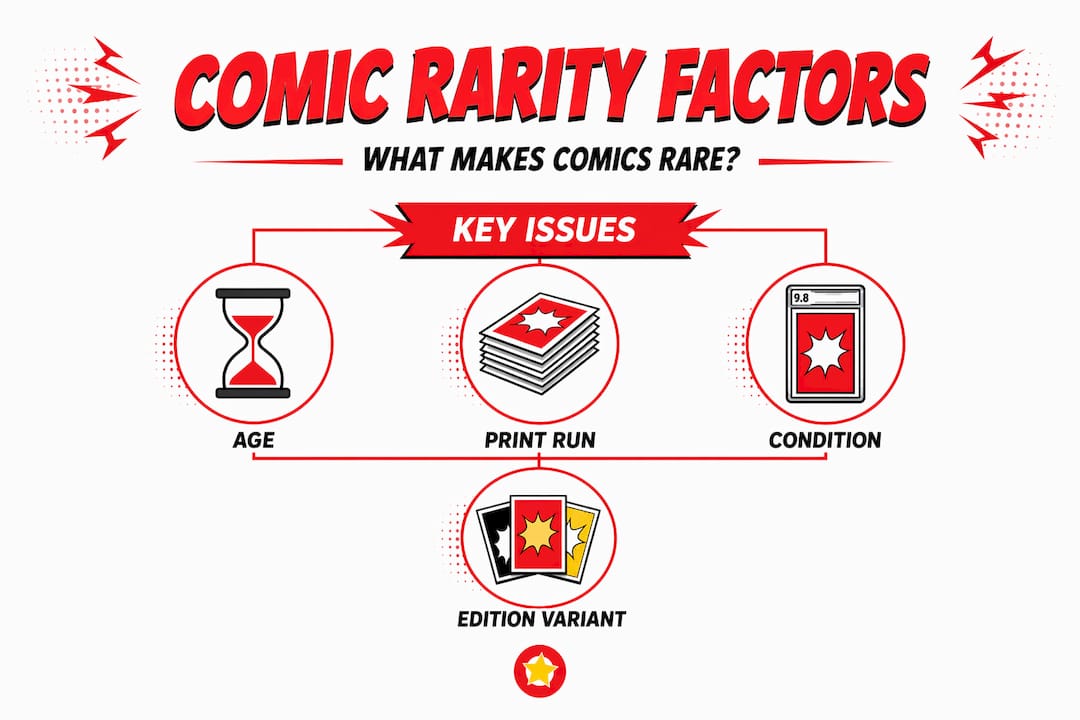
A key issue is any comic that contains a historically significant event: a first appearance, an origin story, the death of a major character, or a creative debut that changed the game. The first appearances of Spider-Man, Batman, and Superman can command three to ten times the value of subsequent issues in the same series. That premium holds even when the print run for those keys wasn’t especially small.
Why does this matter for understanding rarity? Because demand compresses supply. When a film adaptation drops and every collector suddenly wants the first appearance of a character, the available pool of even mediocre copies shrinks overnight. Movie or TV announcements cause immediate price increases for affected key issues. The comic didn’t get rarer. The demand got louder.
Here’s what to watch for when identifying key issues that drive demand-based rarity:
- First appearances of characters who later become franchise mainstays (think Amazing Fantasy #15 for Spider-Man)
- Origin story issues that define a character’s mythology and are constantly referenced by later writers
- First villain appearances, which are often undervalued until a media announcement changes that fast
- Creative team debuts, like a legendary writer or artist’s first issue on a title, which collectors prize for historical significance
Rarity is sometimes less about how many copies exist and more about how many collectors want them right now. The two forces together, physical scarcity and demand, are what truly set the price ceiling.
Edition variants and print errors: hidden rarity in plain sight
This is where the real hunting happens. Two collectors can hold what looks like the exact same issue, and one copy can be worth five times more than the other. The signs of a rare comic book are sometimes baked right into the printing itself.
The newsstand vs. direct market split is the big one for 1980s through early 2010s books. Direct editions were sold through comic shops and kept in better condition. Newsstand copies went to grocery stores and drugstores, got handled roughly, and were returned or destroyed if they didn’t sell. Newsstand sales dropped to about 1% of total distribution before they were discontinued in 2013. That means surviving newsstand copies in high grade are genuinely scarce compared to their direct market counterparts. Knowing this distinction is a core skill for collecting rare comics.
Here’s a quick comic book rarity factors list for variants and errors:
- Price variants: Canadian price variants and other regional printings often had far smaller distributions, making them legitimately rare compared to standard U.S. editions
- Manufacturing errors: Missing ink (entire colors absent from a page), double printing, miscut covers. These are prized by error collectors and can command serious premiums
- Limited foil and platinum editions: Publisher-produced rarities from the 1990s, often promotional copies sent to retailers or distributed in limited quantities
- Recalled issues: Comics pulled from shelves due to printing mistakes or content controversies can have very few surviving copies
The table below shows how edition type affects rarity for a common 1980s Marvel key issue (hypothetical example):
| Edition Type | Estimated Print Quantity | Typical Grade Range of Survivors | Relative Rarity |
|---|---|---|---|
| Direct Market | High | 8.0 to 9.8 | Common |
| Newsstand | Much lower | 5.0 to 8.5 | Moderate to rare |
| Canadian price variant | Very low | 6.0 to 8.0 | Rare |
| Manufacturing error copy | Extremely low | Varies | Very rare |
Silver Age comics rarity also varies sharply by publisher and specific title. Certain 1950s DC publications are far scarcer than highly demanded 1960s Marvel keys, which were printed in larger numbers. Context always wins over assumptions.
How to identify rare comics in your own collection
Okay, so you’ve got a longbox (or ten). How do you actually figure out what might be special? Here’s a practical process that works.
- Check the issue number and title for key issue status. Reference community databases and price guides to see if a book features a first appearance, major death, or origin story. That’s your first filter.
- Examine the cover carefully for edition indicators. Look for price differences (a Canadian price variant often shows a higher cover price), UPC codes vs. no UPC (a common newsstand vs. direct market tell), and any obvious printing irregularities.
- Assess condition honestly. Spine stress, creases, color fading, and staple rust all factor in. This is where learning to evaluate raw vs. graded copies pays off fast.
- Search the CGC census. CGC population counts are publicly searchable and allow you to confirm actual scarcity within specific grade levels. If your issue has 15 total graded copies at 9.4, you’re holding something real.
- Look for restoration. Hold the book under a black light. Restored areas will fluoresce differently. Restoration detection is a critical skill to avoid purchasing overvalued copies that look pristine but are actually patched up.
Pro Tip: Use multiple grading services for cross-reference. CGC is the gold standard, but CBCS also maintains a census. Checking both gives you a fuller picture of how rare your copy actually is in the market.
Our take on how rarity shifts over time
We’ve tracked this market long enough to say this plainly: rarity is not a fixed label. It moves. A book that nobody cared about in 2015 can become a grail book by 2026 because a streaming series announced a character’s debut, or because a key writer championed it publicly.
What we find most interesting, and most underappreciated, is the concept of “Goldilocks” rarity. A book so obscure that only three copies exist is not necessarily a great investment. If nobody knows about it, nobody is bidding on it. The sweet spot is a book rare enough to be genuinely scarce at high grade, but visible enough that an active market of buyers exists to compete for it. That’s where real collector value lives.
Our honest advice? Don’t chase hype blindly. A 9.4 copy of a mid-run issue that suddenly got hot because of a movie announcement can be a great short-term flip, but understand what you’re buying. Also, collecting trends in 2026 are moving fast, and media attention can just as quickly move on. Build your collection around books you genuinely understand and can defend on every rarity factor, not just the loudest hype cycle of the moment. Your future self (and your wallet) will thank you.
Track your rare books with Zap-Kapow Comics Club
Once you know what makes a comic book rare, the next move is tracking those books properly. Zap-Kapow Comics Club gives you real-time price data for both raw and graded copies, so you can see exactly where your rare books sit in the current market. Check trending rare titles to see which key issues are heating up right now, and use the collection management tools to log every book you own with grade, edition, and valuation data. No guesswork. No chasing stale price guides. Just clean, current data that actually helps you make smart collector decisions. Join Zap-Kapow Comics Club at club.zapkapowcomics.com and get your collection under control today.
FAQ
What makes a comic book rare?
A comic book is considered rare when it combines a low print run or survival rate with high collector demand and a key issue designation. Condition at high grades further reduces the effective supply of collectible copies.
Does age automatically make a comic valuable?
No. Age alone doesn’t determine rarity or value. A 1960s comic with a high survival rate in a low-demand title can be worth very little, while a 1990s newsstand variant in top condition can command a serious premium.
How do I use CGC census data to verify rarity?
Search the CGC population report for your specific issue and grade level. If fewer than 100 copies are graded at your target grade, the copy is genuinely scarce. This is the most objective way to confirm rarity claims.
Are newsstand editions always rarer than direct editions?
Generally yes, especially for books published between the early 1980s and 2013. Newsstand distribution dropped to roughly 1% of total copies before discontinuation, making surviving high-grade newsstand copies significantly scarcer.
How does restoration affect a comic’s rarity and value?
Restoration reduces value significantly even at the same numeric grade. CGC marks restored books with a green label, and these copies trade well below unrestored blue-label copies because collector preference for original, untouched books is strong.
Recommended
- How Comic Values Are Calculated: Rarity, Demand and Trends Explained - Zap-Kapow Comics Blog
- 10 Comic Book Collecting & Pricing Trends to Watch in 2026 - Zap-Kapow Comics Blog
- Comic Collection Insurance Appraisal: A Collector’s Guide - Zap-Kapow Comics Blog
- Comic Book Collecting 101: How to Start Your Collection (10 Essential Tips for New Collectors) - Zap-Kapow Comics Blog