
If you think selling a key issue is as simple as pocketing the cash and moving on, the IRS has some thoughts on that. Comic book tax implications explained properly are way more complex than most collectors realize, and the rules are different from selling stocks or real estate. The IRS classifies comics as collectibles, which triggers a separate set of capital gains rules, reporting requirements, and potential deductions. Whether you are flipping silver age keys, donating a run to a library, or trading variants with fellow fans, each of those moves has a tax consequence you need to understand.
Table of Contents
- Key Takeaways
- Comic book tax implications explained: how the IRS classifies your comics
- Calculating your cost basis the right way
- How to report comic book sales on your taxes
- Hobby vs. business: which one are you?
- State taxes, donations, and trading gotchas
- My take: the tax stuff most collectors get wrong
- Track your collection, simplify your tax reporting
- FAQ
Key Takeaways
| Point | Details |
|---|---|
| Comics taxed as collectibles | Long-term gains on comics are taxed at up to 28%, higher than the standard 20% capital gains rate. |
| Cost basis matters big-time | Your taxable gain is reduced by purchase price plus grading fees, shipping, and authentication costs. |
| Report every sale on Form 8949 | All comic sales go on Form 8949 and Schedule D, even if you never receive a 1099 form. |
| Hobby vs. business changes everything | Business classification unlocks expense deductions but also adds self-employment tax obligations. |
| Trades are taxable events | Swapping comics with another collector counts as a sale at fair market value in the eyes of the IRS. |
Comic book tax implications explained: how the IRS classifies your comics
The IRS puts comic books in the “collectibles” bucket, right alongside coins, art, and antiques. That classification is not just a label. It directly determines how much tax you pay on profits.
Long-term gains on collectibles are taxed at a maximum federal rate of 28%. For comparison, most investors pay only 15% to 20% on long-term gains from stocks. So if you bought a Amazing Fantasy #15 reprint for $500 and sold it for $5,000 after holding it for two years, that $4,500 gain could face a 28% federal tax bill. That is a meaningful difference.
Short-term gains (comics sold within 12 months of purchase) are taxed as ordinary income. Depending on your bracket, that could actually push your rate above 28%. The holding period matters, and timing your sales strategically is something we will come back to.
The IRS also draws a line between three types of comic ownership:
- Investment property: You hold the comics expecting them to appreciate. Long-term capital gains rates apply.
- Personal-use property: These are comics in your collection that you genuinely enjoy reading and displaying. Losses on these are generally not deductible.
- Business inventory: You are a dealer, buying and selling comics as a trade. Different rules apply entirely.
The IRS 9-factor test helps determine whether your activity is a business or a hobby. Factors include whether you depend on the income, whether you have turned a profit in at least 3 of the last 5 years, and whether you operate in a businesslike manner with records and a separate bank account.
Pro Tip: Keep your investment comics clearly documented separately from your personal reading collection. Mixing them up creates real headaches when it is time to file.
Calculating your cost basis the right way
Here is where a lot of collectors leave money on the table. Your taxable gain is not just “what I sold it for minus what I paid.” Your cost basis includes acquisition costs like grading fees, shipping, authentication fees, and even sales taxes paid at purchase.
Say you bought an X-Men #1 (1991) for $80 at a convention, paid $8 shipping to get it home, then sent it to CGC for a $35 grading fee. Your actual cost basis is $123, not $80. If you later sell it for $200, your taxable gain is $77, not $120. That grading fee just saved you real tax dollars.
Here is a quick comparison to show how this plays out:
| Scenario | Sale Price | Basis (no fees) | Basis (with fees) | Taxable Gain |
|---|---|---|---|---|
| Basic calculation | $200 | $80 | $123 | $120 vs. $77 |
| CGC 9.8 key issue | $2,000 | $300 | $485 | $1,700 vs. $1,515 |
| Silver age book | $10,000 | $500 | $750 | $9,500 vs. $9,250 |
The common basis adjustments to track include:
- Purchase price paid (including auction premiums)
- Shipping and handling costs
- Grading and authentication fees from CGC, CBCS, or similar services
- Restoration detection or conservation costs
- Sales tax paid at purchase
Maintaining accurate cost basis records is one of the most overlooked practices in the hobby, yet overstated gains from poor documentation are a known audit trigger. Keep receipts. Scan invoices. Save every email confirmation from eBay or a grading service.
Pro Tip: Create a simple spreadsheet the moment you buy a comic. Log the date, price, and every associated cost. Doing it later from memory is a recipe for missing deductions.

How to report comic book sales on your taxes
Okay, so you sold a stack of books at a convention or flipped a few keys on eBay. Now what? Here is the step-by-step for how to report comic book sales correctly.
- Gather your records. Collect every transaction: sale date, gross proceeds, and your adjusted cost basis for each comic sold.
- Determine your holding period. Did you hold each book more than 12 months? Short-term goes in Part I of Form 8949. Long-term goes in Part II.
- Fill out Form 8949. Form 8949 lists each individual sale with the asset description, dates acquired and sold, proceeds, basis, and resulting gain or loss.
- Transfer totals to Schedule D. Schedule D summarizes your total capital gains and losses. Your net collectibles gain flows through here before hitting your Form 1040.
- Apply the 28% collectibles rate. The IRS applies the special collectibles rate to long-term comic book gains, capped at your ordinary income rate if that is lower.
One thing that trips up a lot of collectors: you must report all collectible sales regardless of whether you receive a 1099-B or any other tax form. eBay, Heritage Auctions, and similar platforms may or may not issue a 1099-K depending on thresholds, but your tax obligation exists either way.
Experienced collectors reconcile per-item sales data to their Form 8949 and Schedule D totals before filing. Discrepancies between what a marketplace reported and what you filed are a red flag for IRS matching programs.
Pro Tip: If you sold more than 20 comics in a year, consider using a collection management tool to export transaction data directly into a format your accountant can use for Form 8949 prep.
Hobby vs. business: which one are you?
This is arguably the most tax-impactful question for serious collectors. The classification between hobby and business drives huge differences in what you can deduct and how much you ultimately owe.
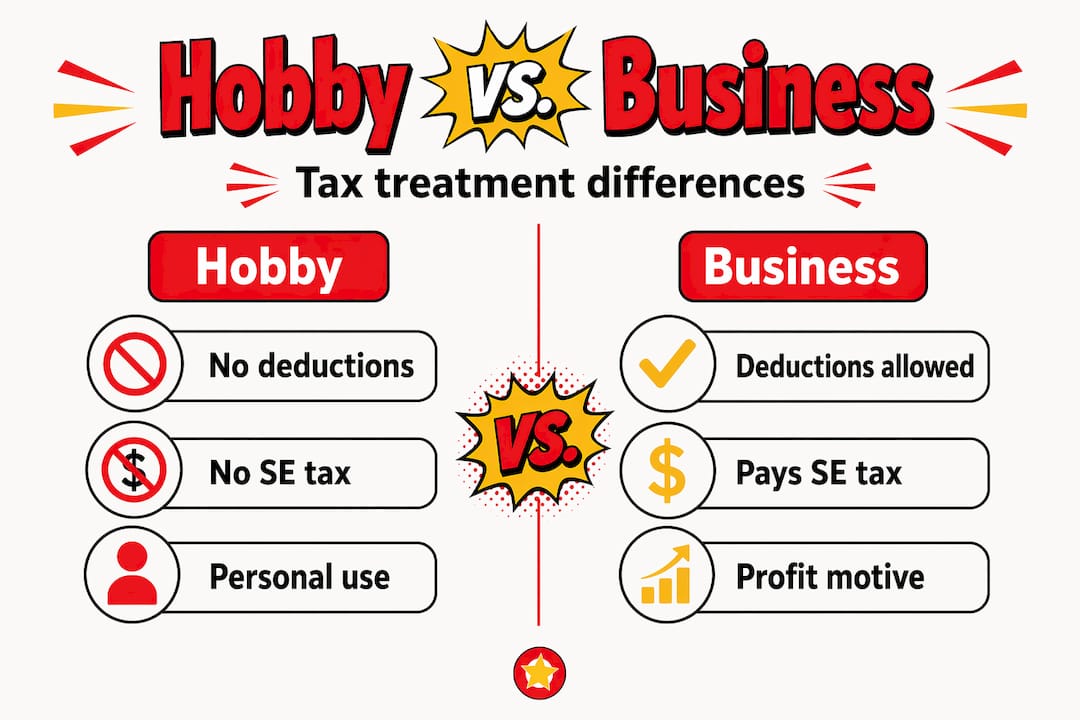
If the IRS considers your collecting a hobby, you cannot deduct losses against other income. You report gains but get limited relief on expenses. That is a rough deal.
If your activity qualifies as a business, you report income and expenses on Schedule C. That means you can deduct:
- Storage and display costs
- Convention attendance and travel
- Grading fees (as a business expense, not just a basis addition)
- Advertising and selling platform fees
- A portion of your home office if used exclusively for the business
The catch? Business classification generates self-employment tax of 15.3% on net profits in addition to income tax. For some collectors, the deductions outweigh this. For others, staying in collectibles capital gains territory is more favorable.
The IRS hobby loss rules require that you show a profit in at least 3 of 5 consecutive tax years to maintain business status. If you cannot meet that bar, the IRS may reclassify your activity as a hobby retroactively.
Pro Tip: If you want business status, act like a business. Open a separate checking account for your comic activity, keep formal records, and document your pricing research and profit intent. Paper trails win audits.
State taxes, donations, and trading gotchas
Federal tax is just part of the story. Here are some additional areas where comic book investment taxes get interesting.
State tax rules vary wildly. New Jersey taxes collectibles gains as ordinary income with no preferential capital gains rate and no capital loss carryforward. That means NJ collectors pay full state income tax on every profitable sale, period. California similarly taxes capital gains as ordinary income. Know your state’s rules before you sell.
Donating comics has its own tax math. If you donate comics to a qualified nonprofit (think a school library or literacy program), you may be able to deduct the fair market value. But the IRS scrutinizes this. Per IRS Publication 561, FMV must be supported by evidence like comparable sales, condition, and recent auction results. A proper appraisal from a qualified appraiser is required for deductions over $5,000. Guessing a number does not cut it, and inflated donation deductions are a known audit trigger.
Trades are taxable. This one surprises almost everyone. Trading or bartering comics is treated as a sale by the IRS. The fair market value of what you receive counts as your proceeds. So if you trade a book worth $300 for one worth $300, you just had a taxable transaction with a gain based on the difference between your basis and $300.
Here is a quick-reference table for these special scenarios:
| Scenario | Tax treatment | Key document needed |
|---|---|---|
| Donating a comic | Deduct FMV with appraisal over $5,000 | IRS Form 8283, qualified appraisal |
| Trading comics | Taxable sale at FMV received | Record FMV of both items, dates |
| Selling in NJ | Ordinary income rate, no capital loss carryforward | State return, full gain reported |
| Tax loss harvesting | Sell at a loss, immediately repurchase | Note: wash sale rule does not apply to collectibles |
One genuinely underused strategy: because the wash sale rule does not apply to collectibles, you can sell a comic at a loss to realize the tax deduction and immediately buy the same issue back. Check out our guide on how comic values are calculated to understand pricing before you make that call.
Pro Tip: For donated comics over $5,000 in value, hire a certified appraiser who specializes in comic books. The IRS does not accept appraisals from the seller or a family member.
Our take: the tax stuff most collectors get wrong
We have seen a lot of collectors treat their hobby like a purely personal thing until the IRS sends a letter. And then, suddenly, the tax rules feel like a supervillain origin story.
The biggest mistake is not documenting basis at purchase. You buy a grail book, pay for grading, resell it two years later for a great profit, and then have zero records. The IRS assumes your basis is zero. That means you pay tax on the full sale price. We have watched that scenario cost collectors thousands of dollars in avoidable tax.
The second mistake is assuming business status is automatically better. Yes, deductions sound great. But if you are genuinely profitable, self-employment tax is brutal. The calculus changes depending on your total income, your profit margin, and how consistently you are turning a profit. A tax professional who understands collectibles (not just one who has “heard of comics”) is worth their fee.
Grading decisions also interact with your tax position in ways most collectors never consider. Submitting a book to CGC adds to your basis, which is good. But it also changes the book’s FMV, which affects everything from a future sale calculation to a donation appraisal. Check out raw vs. graded values before you decide whether to grade a book you plan to sell or donate.
The collectors who pay the least tax are the ones who treat their collection like an investor treats a portfolio. Records, receipts, and strategy. Not a shoebox of eBay printouts.
Track your collection, simplify your tax reporting
Here is the honest truth: most of the tax headaches we covered in this article trace back to one problem. Collectors do not have their purchase prices, grading fees, and sale data organized in one place. When tax time comes, it is a scramble.

That is exactly why Zap-Kapow Comics Club exists. The platform lets you track your collection’s value in real time, with both raw and graded pricing data updated regularly. You can monitor what you paid, what the market says your books are worth now, and how prices have trended over time. That is the foundation of accurate cost basis tracking and solid documentation for Form 8949 prep.
Whether you are managing a small box of keys or a museum-worthy silver age run, Zap-Kapow Comics Club keeps your data clean and your collection organized. Check out our collection organizing tips for a great starting point. When you know your numbers, tax season becomes a whole lot less scary (and a lot less expensive).
FAQ
What tax rate applies to comic book sales?
Long-term gains on comic books are taxed at a maximum federal rate of 28% since they are classified as collectibles. Short-term gains (held under 12 months) are taxed at your ordinary income rate.
Do I have to report comic sales if I never got a 1099?
Yes. You must report all collectible sales regardless of whether you receive a 1099 form. Tax liability exists independent of whether a marketplace issues tax documentation.
What forms do I use to report comic book sales?
You report comic sales on Form 8949 for individual transactions and carry the totals to Schedule D on your federal return. Each transaction should include the date acquired, date sold, proceeds, and adjusted cost basis.
Is trading comics with another collector a taxable event?
Yes. The IRS treats a comic trade as a sale where the fair market value of what you receive counts as your proceeds. You calculate gain or loss based on your original cost basis versus that FMV.
Can I deduct grading fees as a business expense?
If your collecting qualifies as a business, grading fees can be deducted as ordinary business expenses on Schedule C. If you hold comics as investments, grading fees are added to your cost basis and reduce your taxable gain when you sell.
Recommended
- Comic Collection Insurance Appraisal: A Collector’s Guide - Zap-Kapow Comics Blog
- 10 Comic Book Collecting & Pricing Trends to Watch in 2026 - Zap-Kapow Comics Blog
- How Comic Values Are Calculated: Rarity, Demand and Trends Explained - Zap-Kapow Comics Blog
- How to Sell Your Comic Book Collection for Top Dollar: 5 Tips to Maximize Profit - Zap-Kapow Comics Blog