
Cover price variants are comics printed with a different price than the standard issue, usually tied to a limited test market or a separate national edition. Families like Marvel’s 30¢ and 35¢ test copies from the mid-1970s and Canadian price variants (CPVs) from the 1980s regularly carry premiums over their standard counterparts. How much depends almost entirely on identification and grade, which is exactly what we’re going to unpack.
TL;DR:
- Rarity in high grades significantly boosts value, especially for key issues like Iron Fist #14, which is highly sought after in grades above 9.4.
- Accurate identification depends on checking the printed price, UPC placement, and indicia; mislabeling is common and can deceive buyers.
- Canadian variants from the early 1980s are especially scarce in high grades, often commanding premium prices due to limited print runs.
- Market value can vary widely based on provenance, recent sales, and auction factors, making real marketplace data crucial for accurate pricing.
- Using specialized tools and verified sources to track trending prices and census data ensures better research and valuation of price variants.
Table of Contents
- What Are Price Variant Comics, Anyway?
- The Big Three: Marvel 30¢, Marvel 35¢, and Canadian Variants
- How Do You Spot a Price Variant?
- Why Do Some Variants Command Big Premiums?
- What Do Actual Sales Tell Us About Premiums?
- How Should You Research and Document a Variant?
- Where Should You Buy or Sell, and What Should You Watch For?
- Our Take on Where the Variant Market Stands Right Now
- Track Your Variants Before the Market Moves Without You
- Where to Verify Price Variant Data
- Sources
- FAQ
What Are Price Variant Comics, Anyway?
Here’s the deal: a cover price variant, sometimes shortened to CPV, is any comic printed with a cover price that differs from the “normal” copy sitting on the newsstand rack next to it. Collectors sometimes call the earliest examples Type 1 or Type 1A variants, depending on which era and country produced them. The concept isn’t some fringe curiosity, either. It grew out of real distribution quirks, publishers testing new price points in select cities, or printing separate runs for a country with different currency and postal rules.
That’s the mechanism behind most of these oddballs:
- Test markets let publishers gauge reaction to a price hike before rolling it out nationwide.
- Country-specific pricing (Canada being the big one) solved currency and import logistics.
- Newsstand copies took more abuse than direct edition copies sold through comic shops, so survivorship skews rough for a lot of these.
That last point matters more than people think. A variant that’s genuinely rare in raw numbers can still be common in low grade and brutally scarce in high grade, and that gap is where the real money hides.
The Big Three: Marvel 30¢, Marvel 35¢, and Canadian Variants
Three variant families dominate collector conversation, and if you’re going to know anything cold, know these.
- Marvel 30¢ variants (1976). Produced during a nationwide test between April and August 1976, these hit a wide swath of titles, including Amazing Spider-Man #155 through #159 and Avengers #146 through #150. Distribution was uneven across titles and months, so a true complete run is tough to build.
- Marvel 35¢ variants (1977). These are the rarer cousins, born from a much smaller test-market printing run limited to a small number of U.S. cities, places like Memphis and Toledo. Iron Fist #14, Thor #337, and Amazing Spider-Man #252 are the issues collectors chase hardest.
- Canadian price variants (early to mid 1980s). Starting in October 1982, publishers began printing separate higher-priced newsstand batches for Canada (think 75¢ instead of 60¢). CGC now catalogs these formally as “Canadian Price Variant” and they’re some of the toughest high-grade finds in the hobby.
Iron Fist #14 deserves a special callout since it’s basically the poster child for 35¢ variants. If you want to geek out on why that specific Iron Fist issue keeps popping up in collector conversations, its Sabretooth first-appearance status doesn’t hurt either.
How Do You Spot a Price Variant?
Confirming a price variant isn’t guesswork. It’s a checklist, and once you know it, you’ll never look at a cover the same way again.
- Check the price box first. Look for a printed price higher than the standard edition, or small print noting a country designation like “CAN. 75¢.”
- Compare UPC and barcode placement. Direct edition copies usually carry a Spider-Man head or Marvel logo box instead of a barcode; newsstand and variant copies show the actual UPC.
- Read the indicia carefully. The printed month can differ slightly from the distribution month, which is a small tell that’s easy to miss on a phone screen.
- Zoom in. Magnified photos catch tiny print differences that a quick glance never will.
- Look at the slab label. CGC and CBCS both note “Canadian Price Variant” or “35 Cent Variant” directly on the label, but mislabeled slabs do happen.
Pro Tip: Always cross-reference the slab label against the actual cover photo in the listing. Sellers occasionally copy the wrong label text from a template, and that mismatch is your first warning sign of a mislabeled or misdescribed slab.
Why Do Some Variants Command Big Premiums?
Rarity alone doesn’t set the price. Grade concentration does most of the heavy lifting. Specialist CPV guides estimate that Type 1A Canadian variants survive at a very small percentage of census copies for many issues, which sounds dramatic until you realize that stat mostly describes raw survival, not necessarily top-grade survival.
High-grade CGC 9.6 to 9.8 copies matter far more to price than the overall census count, because that’s where actual collector demand concentrates.
Newsstand copies got tossed in bags, rolled up, and read on the bus. Direct edition copies sat in a shop’s bag-and-board rack. That handling gap explains why so many CPVs and 35¢ variants exist in respectable numbers at CGC 6.0 to 7.5, yet turn into ghosts above 9.4. Collectors often overvalue an abundant low-grade CPV while underpricing how rare a genuinely high-grade example is, which is exactly backwards from where the real premium sits.
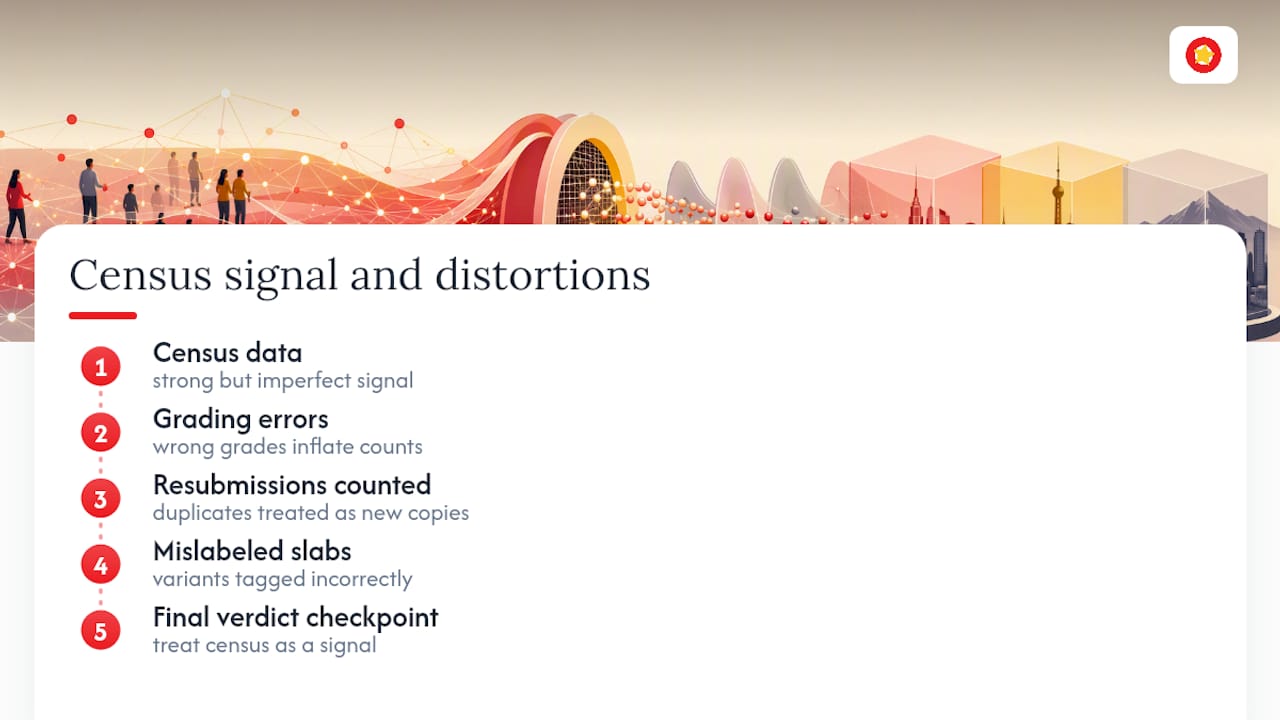
One caution worth repeating: census data isn’t gospel. Grading errors, resubmissions counted as new copies, and outright mislabeled slabs can distort what looks like scarcity. Treat the census as a strong signal, not a final verdict.
What Do Actual Sales Tell Us About Premiums?
Numbers on a guide page are one thing. Watching real sales is another, and the two don’t always agree.
- Low-grade CPVs and 35¢ variants often sell for a modest multiple over a standard copy, sometimes just 20 to 50 percent more.
- High-grade examples of key issues can multiply that gap several times over, especially when a fresh-to-market copy hits auction.
- Marketplace data across specialist CPV sellers shows this variance clearly: some CPVs barely move the needle, while a handful of marquee issues in top grade sell for multiples of their direct edition counterparts.
- Provenance matters. A copy with documented pedigree or a known prior sale at a major auction house tends to outperform an otherwise identical copy with no history.
That last point is why one eye-popping sale you saw on social media shouldn’t set your price expectations. Auction venue, timing, and even bidder rivalry on a given night can turn a single sale into an outlier rather than a market baseline.
How Should You Research and Document a Variant?
Treat every potential variant like a small investigation, not an impulse buy. Here’s the sequence that actually works.
- Run the visual ID checklist. Price box, UPC placement, and indicia month, in that order.
- Check the slab label against CGC’s census. Confirm the notation matches what the physical copy shows, and note where that issue sits in the current census breakdown.
- Cross-check specialist guides and sale records. CPV-focused guides and recent marketplace listings will tell you whether the price you’re seeing is typical or an outlier.
- Document everything. Save photos, note the grade, and set an alert so you know if a comparable copy sells or if new census data shifts the picture.
That’s also where a tool built for this exact workflow earns its keep. Zap-Kapow Comics Club keeps title pages, trending price data, and alerts in one place, so you’re not juggling five browser tabs every time you want to check whether that Iron Fist #14 in your watchlist just got more valuable, or whether the 30¢ variants from series like Marvel Two-In-One are trending up.
Where Should You Buy or Sell, and What Should You Watch For?
Specialty CPV dealers, major auction houses, and general marketplaces each have their own risk profile. Dealers who specialize in variants tend to know the identification quirks cold, but you still pay for that expertise. Auctions give you provenance and competitive pricing, but buyer’s premiums add up fast. General marketplace listings, including eBay’s active search results for 35¢ variants, are the widest net but carry the most risk from inconsistent seller descriptions.
- Get close-up photos of the price box and slab label before you bid, not after.
- Check seller history and return policy; a no-returns listing on a graded slab is a red flag.
- If you suspect a mislabel, pursue re-holdering or third-party verification before you resell.
Pro Tip: Never trust a thumbnail photo for a price variant claim. Ask the seller for a full-resolution shot of the price box specifically. It takes thirty seconds and saves you from buying a standard edition at variant prices.
Our Take on Where the Variant Market Stands Right Now
Demand for documented, high-grade price variants keeps climbing, and census tracking is no longer optional homework. It’s the difference between guessing and knowing. Newer collectors should focus on nailing identification and condition before chasing chase copies; veterans already know the game is about verification speed. Watch for CGC census updates, new CPV guide editions, and sudden auction activity on key issues like Iron Fist #14. Those three signals move faster than most price guides can keep up with.
— Steve
Track Your Variants Before the Market Moves Without You
Most collectors researching a price variant end up juggling census pages, specialist guides, and marketplace tabs just to confirm one comic is worth the ask. Zap-Kapow Comics Club puts that entire workflow in one place, tracking raw and graded values side by side so you’re not reconciling three different sources every time a Canadian price variant pops up in your feed.
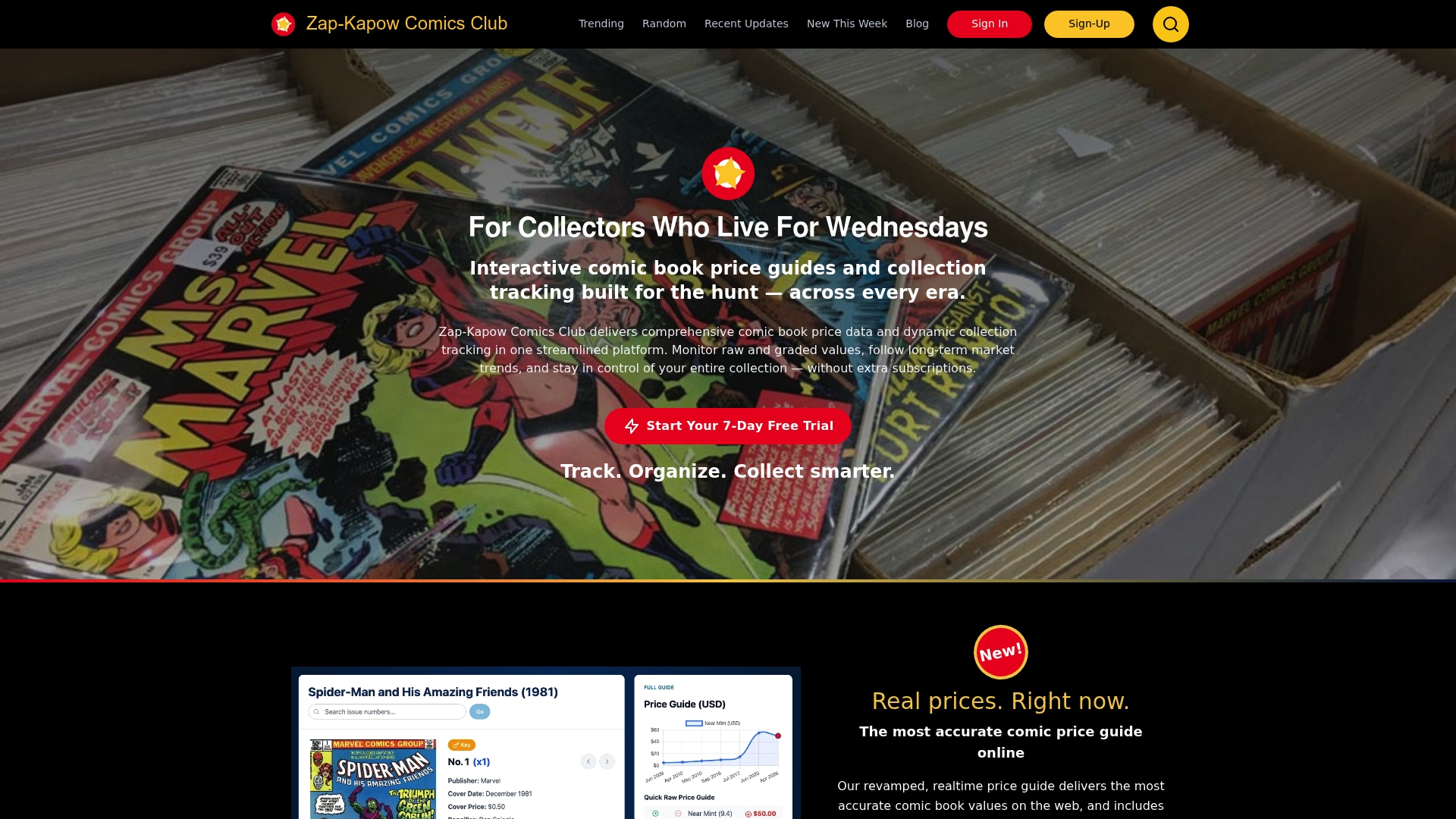
The platform’s title pages and trending data cover exactly the series collectors chase hardest, whether that’s Iron Fist, Amazing Spider-Man, or the broader universe of high-value Marvel books. Set alerts on a candidate issue, watch its trend line move, and export your collection whenever you want without piling on extra subscriptions. If you’ve got a variant sitting in a box that you’ve been meaning to research properly, start by looking it up on the comic book values and price guide and see where it actually sits in today’s market.
Where to Verify Price Variant Data
Cross-check any variant claim against a specialist source before you buy or sell. The Marvel 35¢ price variant list, CGC’s census pages, and Canadian price variant guides remain the most reliable starting points. Zap-Kapow Comics Club members also get title pages and trending value reports for ongoing reference.
Sources
FAQ
What Is a Cover Price Variant in Comic Books?
A cover price variant is a comic printed with a different price than the standard edition, usually from a test market or a separate country-specific print run like Canadian price variants.
Why Are Marvel 35¢ Variants So Valuable?
They came from a limited test-market printing in roughly four to six U.S. cities in 1977, making surviving copies genuinely scarce, especially issues like Iron Fist #14 and Amazing Spider-Man #252.
How Do I Tell a Canadian Price Variant From a Standard Copy?
Check the price box for a higher printed amount (often 75¢ instead of 60¢) and confirm the UPC placement, since Canadian price variants were printed as separate newsstand batches starting in October 1982.
Does a High CGC Grade Always Mean a Higher Price?
Usually, yes, especially for variants where high-grade survival is far scarcer than the overall census suggests, though provenance and auction timing can still swing individual sale prices.
Can I Track Price Variant Values Over Time?
Yes. Tools like Zap-Kapow Comics Club track trending values and let you set alerts, so you can watch a specific variant’s price move instead of checking guides manually.